Monument & Free Standing Sign Types
Freestanding signs are permanently fixed to the ground and not connected to a building, which makes them flexible in placement and highly visible from passing traffic. Monument signs are one type within this broader family, and the right style depends on your property, your visibility goals, and local zoning requirements.
Here’s how the main freestanding sign types compare:
Monument Signs
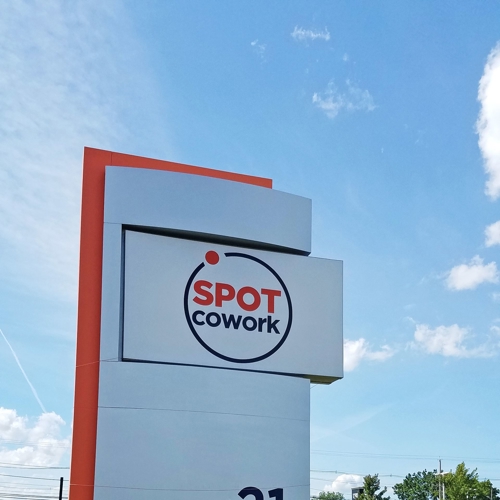
A sturdy sign made up of dimensional letters or a cabinet that often sits flush with the ground. Monument signs are lower-profile and designed to integrate with landscaping and architecture at a property entrance. They can be illuminated with LED lighting for around-the-clock visibility or left non-illuminated for a more architectural look. Common materials include aluminum, brick, concrete, masonry, and high-density urethane (HDU), each lending a different character to the finished sign.
Pylon Signs
Pylon signs are taller structures mounted on one or two poles, built for high-traffic roads and highway corridors where visibility from a distance is the priority. They’re the right call when a monument sign’s lower profile wouldn’t clear traffic or landscaping.
Pole Signs & Pedestal Signs
Pole signs use a single support column and are common at fuel stations and fast-food locations. Pedestal signs sit on a wider base that resembles a monument style but may be elevated. Both serve specific visibility and branding needs depending on site conditions.
Multi-Tenant Monument Signs
Office parks, shopping centers, and mixed-use developments often need one sign to represent multiple businesses at a shared entrance. Multi-tenant monument signs organize that information clearly, giving each tenant visible representation without cluttering the property entrance.
Who Uses Monument Signs in Dallas
Across Dallas, Monument & Free Standing Signs appear wherever a business or institution needs reliable identification at a property entrance. The settings vary widely, but the need is consistent: be visible, look professional, and guide people where they need to go.
- Corporate offices and business parks use monument signs to signal brand presence at the roadside and create a polished first impression for clients and employees.
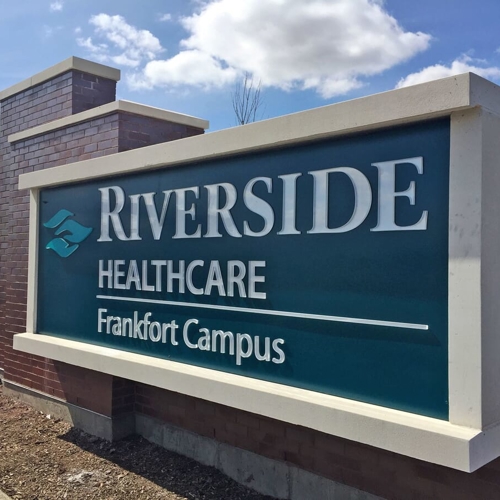
- Healthcare facilities and medical campuses rely on monument signs for entrance identification and wayfinding, helping patients and visitors locate the right building.
- Retail plazas and shopping centers use multi-tenant monument signs to display multiple businesses at a single entrance, increasing visibility for every tenant.
- Schools, universities, and educational campuses use monument signs for campus identification that communicates permanence and institutional identity.
- Religious organizations and community centers use monument signs for welcoming, durable identification that serves their congregation and the surrounding neighborhood.
- Apartment complexes and residential developments use entrance monument signs to signal quality and guide residents and guests to the right location.
Dallas’s mix of modern business parks and established neighborhoods means monument sign design can’t be one-size-fits-all. The right sign for a contemporary medical campus looks different from the right sign for a historic retail district, and our design process accounts for that.
How Our Monument Sign Process Works
We manage monument sign projects from the first conversation through the day the sign goes in the ground. Here’s what that looks like in practice.
Consultation & Design
We start by learning about your business, your property, and your goals. Our graphic designers then produce custom visuals aligned to your brand before anything moves to production.
Site Survey & Permitting
A site survey determines optimal sign placement based on traffic sightlines, setback requirements, and the physical characteristics of your property. Our team manages the permit application with the relevant city, since requirements vary by zoning, sign size, and location across the Dallas area.
Project Management
One project manager oversees your job from design approval through installation. You don’t coordinate between multiple vendors or chase down status updates. We handle it and keep you informed.
Installation
Professional installation ensures your sign is structurally sound, properly positioned, and meets local code requirements. When the job is done, your sign is ready to work.