Regulatory Signs, Safety Signs & ADA-Compliant Signs in Sugar Land
Full-Service Compliance Signage for Sugar Land Businesses
Every commercial facility in Sugar Land communicates something through its signs: where to go, what to watch out for, who’s welcome, and what the rules are. At FASTSIGNS® of Sugar Land, TX, we handle Regulatory Signs, Safety Signs, and Custom Accessible Signage as part of a complete visual communication strategy, giving you consistent, compliant signage across your entire space.
We’re locally owned and operated, serving organizations throughout Fort Bend County, including:
Retail stores
Manufacturing facilities
Schools
Hospitals
Churches
Government installations
Our visual communication professionals, graphic designers, and project managers take projects from initial consultation through final installation.
Call (281) 783-3845 to discuss the signs your facility needs.
Three Sign Categories, One Place to Order Them
Most facilities need signs from all three categories. Ordering them together means consistent design, coordinated production, and a single point of contact for the whole project.
Regulatory & Warning Signs
Regulatory and warning signs inform visitors and employees of laws, policies, and requirements. You’ll find them in stairwells, elevators, fire exits, entryways, and parking areas. We produce custom versions that clearly communicate what your facility requires without looking like generic afterthoughts.
Workplace Safety Signs & OSHA Signage
Compliance signs, workplace safety signs, and OSHA signage are essential anywhere hazard communication is required, including construction sites, warehouses, manufacturing floors, and similar environments. We produce indoor and outdoor versions for projects ranging from a single sign to signage for an entire campus.
We also account for established OSHA signal colors when specifying each message.
ADA Compliant Signs in Sugar Land
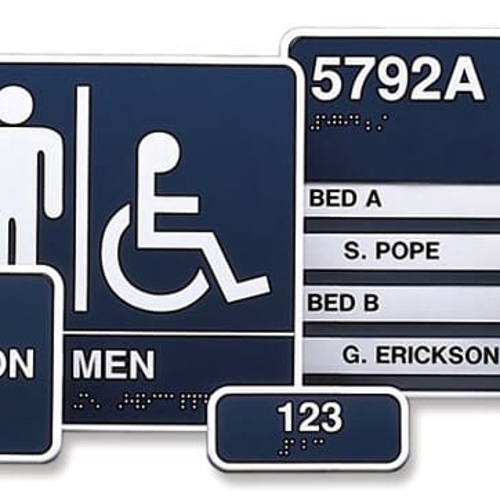
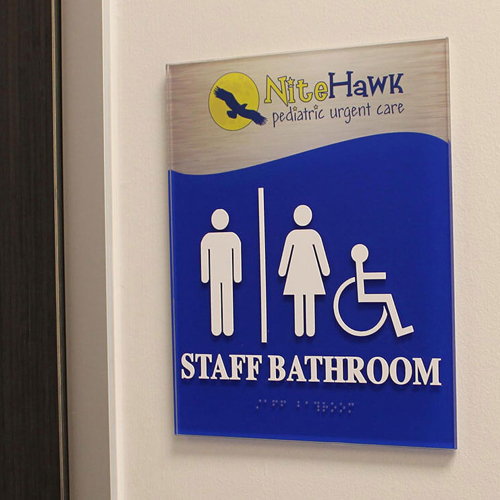
The Americans with Disabilities Act of 1990 requires businesses to provide accessible signage throughout their premises. Our ADA-compliant signs, including braille and graphic signs, combine required tactile lettering and braille with design that fits your space and reflects your brand. We don’t treat compliance as a constraint on design; we treat it as a starting point.
How We Help Sugar Land Businesses Get Signage Right
We begin by reviewing the spaces involved, the purpose of each sign, and the requirements that apply to the project. Sign location, viewing conditions, material needs, and installation conditions determine the specifications for each sign.
Compliance verification is built into our production process. Before bulk orders go to production, our team confirms that each sign meets the applicable standards based on the specifics you provide. This approach reduces the chance of discovering a problem after installation.
We guide you in creating ADA signage in Sugar Land that fits your space, matches your environment, and meets safety and compliance requirements. Our services include:
You won’t have to coordinate multiple vendors to finish the project.
Once the sign details are set, we coordinate production and installation as required. This provides one process for regulatory and warning signs, workplace safety signs, and accessible signage throughout the facility.
FASTSIGNS® of Sugar Land, TX holds a 5.0 average rating on Google, and some clients have worked with us for nearly 10 years on projects ranging from office signage to HOA signs. Those relationships come from doing the work carefully and communicating clearly at every step.
Start Your Signage Project Today
Whether you need a handful of ADA-compliant signs in Sugar Land or a full set of regulatory, safety, and accessible signage for a new facility, we can determine what you need and build it. You can request a quote for any number of signs, and our team will walk you through the process from there.
ADA standards shape accessible sign design, production, and installation. Accounting for them early prevents surprises later in the project.
Texas facilities must also account for the Texas Accessibility Standards, which are enforced through the Texas Department of Licensing and Regulation Architectural Barriers Program alongside applicable federal ADA requirements.
Contrast, Font & Tactile Characters
ADA-compliant signs must provide sufficient contrast between visual characters and their background, although the 2010 ADA Standards don’t establish a numeric contrast ratio. Required tactile characters use an uppercase, sans-serif font without decorative elements and must be between 5/8 inch and 2 inches in height. Where a sign includes a pictogram identifying a permanent space, tactile text descriptors are also required. ADA-compliant signs for permanent rooms and spaces must include Grade 2 Braille and raised characters to serve visitors with visual impairments.
Braille Placement
Grade 2 Braille must appear below the corresponding text on the sign. For multi-line text, braille must be placed below the entire text block. A minimum 3/8 inch space is required between the braille and any other sign elements, including borders.
Mounting Height & Placement
The baseline of the lowest raised character must sit at a minimum of 48 inches above the finished floor; the baseline of the highest raised character must not exceed 60 inches above the finished floor. Signs should be installed on the latch side of the door for the room they identify. Per the ADA Standards for Accessible Design, signs may be placed on the push side of doors that have closers and no hold-open devices.
Safety Sign Color Coding & Pictograms
Safety signage follows standardized color coding so people can understand the message even before reading the text. Pictograms serve a similar function by representing concepts through widely understood illustrations and making the core message clear at a glance.
What the Standard Colors Mean
OSHA and ANSI Z535.1 color standards distinguish danger, warning, caution, safety instruction, and notice messages. Knowing which standard applies helps when specifying a sign for a particular hazard or instruction.
Red: Danger and fire protection equipment
Orange: Warning messages under ANSI Z535.1
Yellow: Caution and physical hazards, including stumbling or caught-in-between hazards
Green: Safety and first-aid instructions
Blue: Notice information under ANSI Z535.1 rather than hazard communication
Black: Lettering or panels used with required signal colors
How Pictograms Work
Pictograms appear in chemical hazard warnings, emergency exit signs, and health hazard indicators. Their strength is immediacy: a pictogram communicates across language barriers and in conditions where someone doesn’t have time to read a sentence.
Sign size matters too. A sign needs to be large enough to read clearly from the distance at which someone will need to act on the information, and the right size depends on the viewing distance in your specific environment.
Where Accessible Signs Are Required
Accessible sign requirements vary according to the location and purpose of the sign. Permanent room identification, directional information, accessible features, and exit routes don’t all follow identical technical specifications.
Common locations that require accessible identification or directional signage include:
Permanent rooms and spaces such as restrooms, locker rooms, cafeterias, libraries, conference rooms, and mechanical rooms
Exit stairways, exit passageways, and exit discharge doors
Accessible entrances, toilet and bathing rooms, parking spaces, and checkout aisles
Existing accessible elevators when corresponding elevators aren’t all accessible
Permanent room signs and required exit signs require raised characters and Grade 2 Braille. The International Symbol of Accessibility identifies or directs visitors to accessible entrances and other accessible facility elements when not all corresponding elements are accessible.
Resolving Accessible Sign Requirements Before Production
Missing, incorrectly specified, or poorly placed signs can make a facility harder to navigate and create accessibility concerns after installation. Reviewing room identification, accessible routes, exits, parking areas, and facility-use requirements before production identifies necessary signs while details can still be corrected.
ADA Title III complaints can be resolved through mediation. If settlement negotiations fail or a violation raises broader concerns, the Department of Justice may bring a lawsuit against a business. A project-specific review of sign content, placement, tactile features, accessibility symbols, and mounting conditions provides a clearer production plan before signs are made and installed.