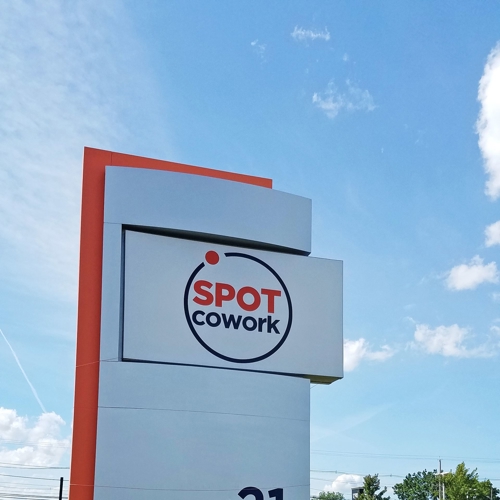
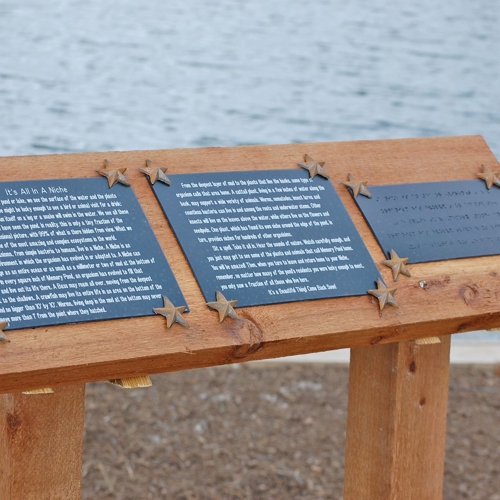
We’re locally owned and operated, and we serve businesses throughout Auburn Hills and Oakland County. Auburn Hills encourages monument or decorative two-post signs in non-residential zoning districts, so local requirements belong in the conversation from the earliest site and design decisions. The property entrance, vehicle approach, available sightlines, and required setbacks all influence which structure and placement make sense.
Call us at (248) 621-8292 to discuss the right sign structure for your property.
A Full-Service Process, Not Just a Product
Coordinating separate vendors for fabrication, installation, and permitting creates handoffs and delays. Fadi and the FASTSIGNS® of Auburn Hills, MI team coordinate every phase, so design proofs reflect fabrication realities, site evaluations account for sightlines and setback distances, and permit submissions use conditions we’ve confirmed in the field.
We install monument signs and obtain the appropriate permits if needed to support adherence to local codes and requirements. Our survey and permitting services guide you through the applicable requirements rather than leaving you to sort them out on your own. Customers regularly note our responsive, start-to-finish guidance in reviews. Our visual communication professionals, project managers, and graphic designers plan each monument sign around your property, visibility needs, and goals.
Because the design proof, site evaluation, production requirements, and installation plan are handled together, you have one team following the project from the initial concept to the finished sign.
Start Your Monument Sign Project in Oakland County
Whether you’re opening a new location or replacing an outdated entrance sign, FASTSIGNS® of Auburn Hills, MI can take the project from a blank canvas to an installed sign. We serve businesses throughout Auburn Hills and Oakland County, coordinating each phase through installation.
Contact us at (248) 621-8292 to discuss your project. At FASTSIGNS® of Auburn Hills, MI, we can get back to you promptly.
Monument Signs, Pylon Signs & Other Freestanding Sign Types
Ground-mounted signs vary in their support structures and visibility profiles. A monument sign sits on a permanent foundation or decorative base without exposed poles or posts. Pole, pylon, and pedestal signs use different support systems to address site constraints and viewing distances.
Common freestanding sign structures include:
Monument signs: Structures built close to the ground with a solid architectural base, often constructed with dimensional letters or a cabinet face. They’re well suited to business entrances, corporate parks, and residential communities where the sign should coordinate with the surrounding property.
Pylon signs: Elevated structures that make tenants or organizations visible to drivers from a greater distance. Retail centers, gas stations, and roadside businesses use them where long-range visibility is a priority.
Pole signs: Sign cabinets supported by one or more poles, columns, uprights, or braces permanently affixed to the ground. They’re used where additional height is needed or a monument base isn’t practical for the site.
Pedestal signs: Finished, base-supported structures with a slimmer profile than many monument signs. Their narrower footprint can suit entrances with limited space.
Materials, Illumination & Zoning Considerations
At FASTSIGNS® of Auburn Hills, MI, our material options include:
Aluminum
Welded metal
Brick masonry
Stone
High-Density Urethane
High-Density Urethane is a lightweight foam composite that can replicate the dimensional appearance of carved stone or wood. The structure can be non-illuminated or built with integrated LED lighting, depending on the property’s visibility needs.
Auburn Hills limits freestanding signs in non-residential zoning districts to 20 feet in height and one sign per vehicle entrance, excluding directional signs. A freestanding sign requires a setback equal to its height and must remain at least three feet from the right-of-way. It also must be at least 100 feet from the boundary of a one-family residential district.
When a pole sign is used in a non-residential district, Auburn Hills requires the steel support pole to be wrapped with compatible sign material equal to 30% of the sign width. Residential identification signs with a low-profile monument base or decorative two-post structure can’t exceed six feet in height or 32 square feet in area. Knowing the rules before committing to a direction can help avoid costly redesigns later. Reviewing these requirements before fabrication helps keep the proposed dimensions, support structure, and placement aligned with the site plan.
Who Uses Monument & Free Standing Signs in Oakland County
At FASTSIGNS® of Auburn Hills, MI, we fabricate and install signage for organizations and managed properties throughout Auburn Hills and Oakland County. The right format depends on how people approach the property, how far away they need to read the sign, and whether they need identification, orientation, or tenant information.
Properties that use monument and freestanding signs include:
Business parks and office complexes: Multi-tenant monument signs serve as entrance directories that identify each tenant and guide visitors to the right suite or building.
Corporate campuses: Monument structures at major entrances establish a unified aesthetic and orient visiting clients from the moment they arrive.
Healthcare facilities: Highly visible ground-mounted signs help route patients and visitors to correct entrances, parking zones, and departments.
Retail centers and shopping plazas: Illuminated pylon signs and monument signs support roadway visibility and anchor the property’s visual identity.
Residential communities and HOAs: Entrance monument signs identify the community, enhance curb appeal, and establish a sense of place for residents and guests.
Schools, colleges and houses of worship: Monument signs mark main entrances, display the organization’s name and logo, and support campus navigation for first-time visitors.
Site access and vehicle approach routes are especially important when selecting the structure and placement. A monument sign can identify a primary entrance at close range, while a pylon sign addresses properties that need to communicate from farther down the roadway. For multi-building sites, the entrance sign can also establish the first point in a broader visitor wayfinding system.