Monument Signs, Pylon Signs & More: Which Format Fits Your Property
Freestanding signs aren’t one-size-fits-all. The right format depends on your property layout, road speed, available sight lines, and local zoning rules. Here’s how the main types differ.
Monument Signs
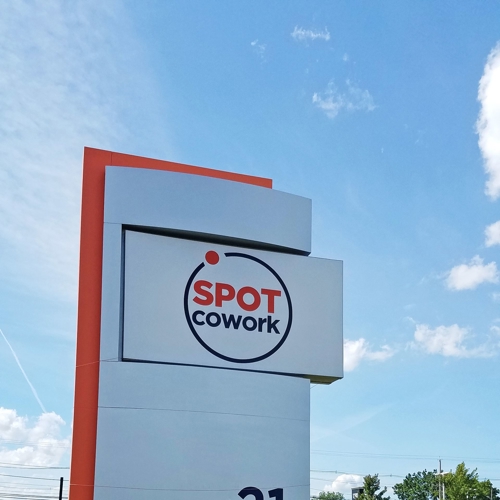
Monument signs sit low to the ground on a solid base, giving them a substantial, architectural look. That profile works well at property entrances where height limits are strict or where a permanent, built-in appearance fits the character of the development. Office parks, medical campuses, and retail centers commonly use this format for tenant directories and property identification.
Pylon Signs
Pylon signs are supported by one or two vertical poles and rise well above surrounding structures, making them readable from a greater distance and across multiple lanes of traffic. Detroit businesses on high-traffic corridors rely on this format for exactly that reach. A single-pole design works where ground footprint is limited; two-pole configurations accommodate larger displays and multi-tenant panels listing several businesses on one structure.
Pole & Pedestal Signs
Pole and pedestal signs offer a middle ground in height and visual weight. Pedestal designs share the low-profile, solid-base look of monument signs but with a narrower footprint. Pole signs provide elevation without the full visual mass of a pylon, which suits certain zoning contexts and property types.
Choosing between these formats means weighing property setback distances, how fast traffic moves on the adjacent road, and what local zoning allows for sign height and square footage. Our team can assess those factors during the site survey and recommend the format that serves your visibility goals within the applicable rules.
Where Freestanding Signs Deliver the Most Value
Monument and freestanding signs solve a specific problem: they tell arriving customers they’ve found the right place and show them exactly where to enter. That problem appears across a wide range of property types.
- Business parks and office complexes use monument signs as entrance directories, listing tenant names so visitors can navigate without calling ahead.
- Retail centers and shopping plazas use roadside signage to attract passing traffic, promote current offers, and anchor the property’s street presence.
- Healthcare facilities and campuses rely on clearly identified entrances for patient wayfinding and, in some cases, emergency services routing.
- Residential communities mark their entrances with monument signs that identify the development and set the tone for the property.
- Any first-visit destination benefits from a sign at the street that confirms the address and signals where to turn.
Illumination & Digital Display Options
Monument and freestanding signs can be built as non-illuminated structures or fitted with lighting that keeps them visible after dark and in low-light conditions. For Detroit businesses with evening hours or locations on high-traffic corridors, that extended visibility is a practical advantage over a sign that goes dark at sunset.
LED lighting is the standard for illuminated freestanding signs. LEDs consume significantly less energy than older fluorescent systems and last considerably longer, reducing operating costs over the life of the sign. Internal lightboxes illuminate cabinet-style signs evenly, while external lighting suits dimensional letter applications.
Digital display panels extend what a freestanding sign can do. Instead of a fixed message, a digital sign can rotate promotions, announce events, update hours, and display multi-tenant listings that change as tenants turn over. These displays are managed remotely, so updating the message doesn’t require a service visit. For retail and hospitality properties especially, that flexibility can extend the return on a monument sign investment.
Our Process for Monument & Free Standing Sign Projects
Projects follow the same sequence, and we handle each stage in-house rather than farming steps out to subcontractors.
Survey & Permitting
Before any design work begins, our team assesses the property: measuring setbacks, evaluating sight lines from the roadway, identifying utility locations, and noting soil conditions that affect foundation requirements. What we find during the survey directly informs the design and the permit application. Detroit-area municipalities require permit approval before installation can start. The permit package typically includes design drawings, structural specifications, and documentation showing compliance with local zoning rules on height, setback, and sign area. Our Survey and Permitting service handles that submission and follows the application through approval. Permit timelines vary by municipality and project complexity, so we factor that into the schedule from day one.
Graphic Design & Content Development
Our in-house Graphic Design and Content Development work runs parallel to permitting wherever possible. Designers work from your brand standards to create a sign face that holds up at road speed and in varying light conditions. Keeping this step in-house means faster revisions and a design that stays consistent with the structural format being fabricated.
Fabrication & Installation Services
Once permits are approved and design is finalized, fabrication begins. Our Installation Services team completes the physical installation, from foundation work through final mounting and electrical connection on illuminated signs. Project Management coordinates every handoff so the move from fabrication to installation stays on schedule and nothing stays on your plate.
If you’re exploring monument signs in Detroit for a new development or a property refresh, this is the process we use to get from your first call to an installed sign without leaving the coordination work on your plate.