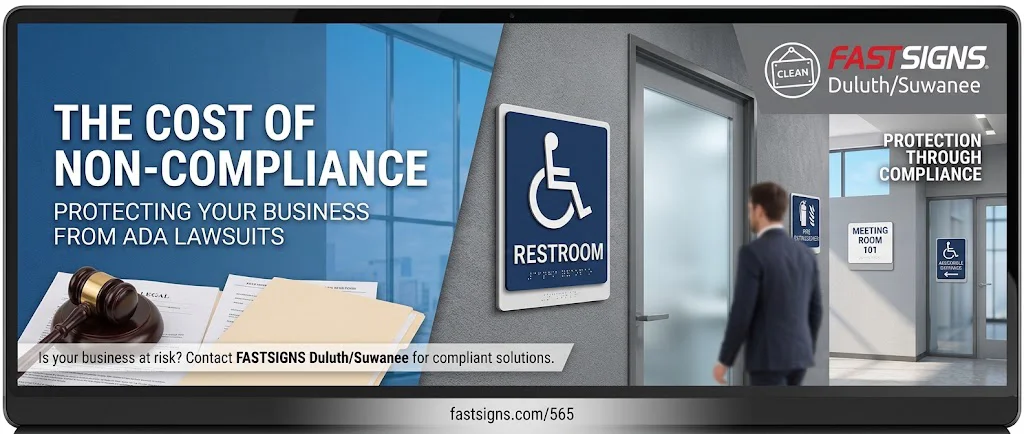
Running a business comes with a long list of priorities. You are managing inventory, keeping customers happy, and making sure the lights stay on. It is easy to look at indoor signage as a small cosmetic detail. However, when it comes to the Americans with Disabilities Act (ADA), signage is a critical legal requirement.
Think of ADA sign compliance less like a bureaucratic hurdle and more like an insurance policy. Taking care of your signage proactively keeps your doors open to everyone, improves navigation for visitors, and protects your bottom line from unexpected legal troubles.
The Real Cost of Skipping ADA Compliance
Ignoring ADA standards can get expensive fast. Federal civil penalties for a first-time violation can reach up to $75,000, with subsequent violations capping at $150,000.
On top of federal fines, state-level regulations and private lawsuits add up quickly. serial litigants often target physical locations for minor, easily fixable signage errors. A single lawsuit can force you to cover legal fees, pay settlement costs, and replace all non-compliant signage under a tight court deadline.
Updating your facility with custom, high-quality ADA signs costs a fraction of a single legal claim. Investing in proper signage early blocks liability before it turns into a headache.
Which Spaces Legally Require ADA Signage?
A common myth is that every door in a building needs Grade 2 Braille and raised lettering. In reality, the ADA specifically focuses on permanent interior spaces. If a room’s purpose will not change for seven days or longer, it almost certainly requires compliant signage.
Here are the key areas you need to cover:
Restrooms: Every permanent bathroom needs clear identification, including tactile lettering, braille, and standard accessibility symbols.
Exit Doors & Stairwells: Signs must clearly mark emergency exits, stairways, and room entry points to ensure safety during evacuations.
Utility & Maintenance Rooms: Electrical closets, mechanical rooms, boiler spaces, and storage areas require proper labels so maintenance workers and first responders can identify them quickly.
Permanent Offices & Conference Rooms: Rooms with dedicated functions (like "Conference Room A" or "Breakroom") must have proper tactile labels on the latch side of the wall.
Temporary signage—like a printed paper notice taped to a door for an afternoon meeting—does not need to meet these strict design rules. But for everything else, permanent standards apply.
3 Common Signage Traps (and How to Avoid Them)
You do not need to be a regulatory expert to spot compliance mistakes. Many businesses order custom signs that look great but fail inspection due to simple placement or material errors.
1. Mounting Height Errors
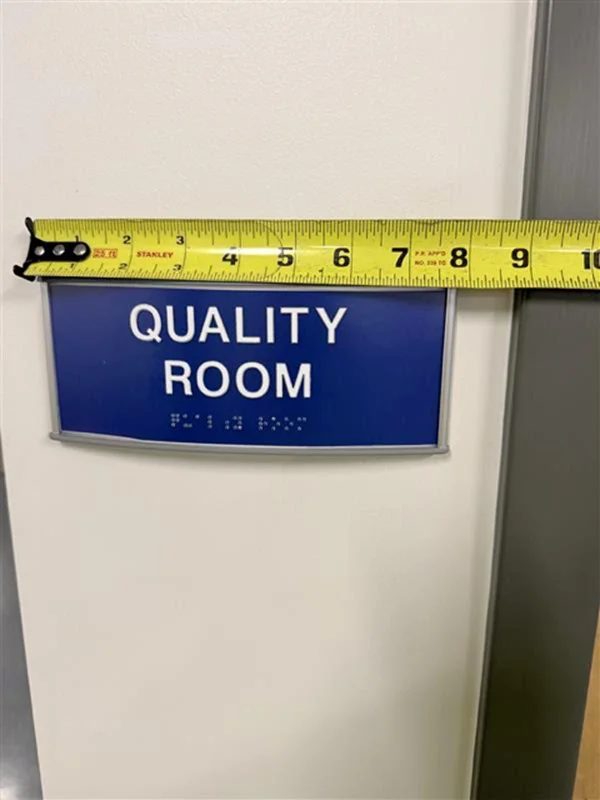
Signs are often mounted too high or directly on doors. Under ADA guidelines, visual signs must be installed so the baseline of the lowest tactile characters sits at least 48 inches off the floor, while the highest characters do not exceed 60 inches. Additionally, signs should be mounted on the wall adjacent to the latch side of the door—not on the door itself—so someone reading tactile lettering isn't bumped when the door opens.
2. Missing or Incorrect Grade 2 Braille
Standard text alone is not enough for tactile room labels. Signs identifying permanent spaces must feature domed Grade 2 Braille. Using flat printed dots or placing braille too close to the text border violates accessibility standards and makes the sign unusable for visually impaired visitors.
3. Shiny, High-Glare Finishes
A glossy finish might match your modern interior design, but reflective surfaces make signs hard to read under standard fluorescent lighting. ADA regulations require a non-glare finish (such as matte or eggshell) along with high visual contrast between the background and text (e.g., light text on a dark background, or dark text on a light background).
Frequently Asked Questions About ADA Signs
What is the 48-to-60-inch rule for ADA signs?
This rule dictates the vertical installation window for tactile signs. The bottom of the lowest raised character must be at least 48 inches above the finished floor, and the top of the highest tactile character must sit no higher than 60 inches.
Does every sign in my building need Braille?
No. Braille is only required on signs that identify permanent rooms or spaces (like restrooms, exits, and room numbers). Directional signs (like an arrow pointing toward a lobby) or informational signs (like opening hours) need high contrast and non-glare finishes, but do not require tactile text or braille.
What are the penalties for non-compliant signs?
Federal fines start at up to $75,000 for a first violation and up to $150,000 for subsequent violations. Businesses may also face private lawsuits, legal fees, and mandated remediation costs.
Can I install ADA signs on glass walls?
Yes! When mounting signs on glass next to a doorway, install the sign on the glass panel adjacent to the latch side using double-sided adhesive. You can also add a backing plate on the inside of the glass to hide tape marks and keep your office looking clean.
Protect Your Business with FASTSIGNS
Achieving complete ADA sign compliance does not have to be confusing or stressful. Whether you are updating an existing facility or opening a new location, working with an experienced partner ensures every sign meets federal, state, and local codes.
Don't wait for a costly compliance audit or legal warning to check your facility's signs. Contact our local team today at 770-954-8081 or visit us at 2148 Duluth Hwy #107 Duluth, GA to schedule a site audit and keep your business accessible, safe, and fully protected.


