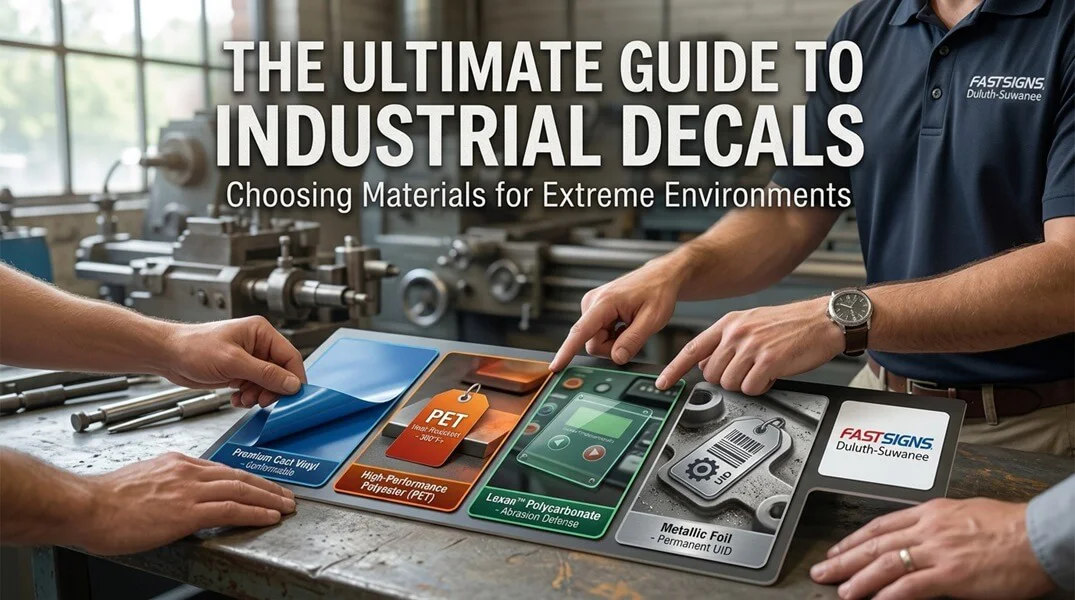
Commercial machinery, construction fleets, and manufacturing equipment operate under some of the harshest conditions imaginable. Whether subjected to scorching summer heat, freezing winter moisture, hydraulic fluids, intense UV radiation, or heavy mechanical abrasion, industrial graphics are expected to perform without peeling, fading, or cracking.
A standard paper sticker or promotional vinyl decal will rapidly degrade when exposed to outdoor elements or harsh chemical washdowns. When graphics fail on industrial equipment, the consequences go beyond optics—missing safety warnings, illegible serial numbers, or degraded brand markings can create compliance risks, operational confusion, and unnecessary safety hazards.
This practical guide breaks down the science of custom industrial decals, comparing core substrates, protective laminates, high-tack adhesives, and critical environmental factors to consider when ordering heavy equipment decals for your business.
Industrial Decals vs. Standard Stickers: What’s the Difference?
To understand why heavy equipment requires specialized graphics, it helps to compare standard commercial stickers against engineered industrial decals across four key performance metrics:
Performance Metric | Standard Commercial Stickers | Heavy-Duty Custom Industrial Decals |
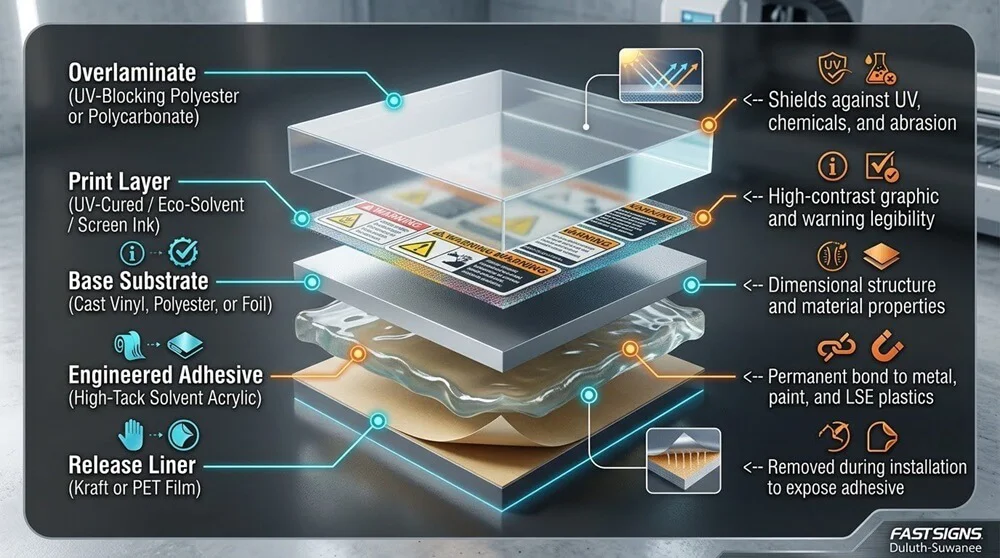
Base Material (Substrate) | Calendered vinyl or paper stock | Cast vinyl, polyester (PET), polycarbonate, or aluminum foil |
Adhesive Type | Water-based or standard acrylic | High-tack, high-shear acrylic engineered for low-energy plastics & rough metals |
Lamination & Shielding | Uncoated or light liquid gloss | Thick UV-blocking polyester, matte polycarbonate, or textured floor laminates |
Environmental Tolerance | Short-term indoor/light outdoor exposure (-10°F to 140°F) | Extreme chemical, solvent, grease, abrasion, and temperature resistance (-40°F to 300°F+) |
While standard stickers rely on pressure-sensitive adhesives meant for smooth, flat indoor surfaces (such as packaging or promotional handouts), custom industrial decals are custom-engineered assemblies designed to bond chemically to powder-coated steel, cast iron, fiberglass, or low-surface-energy (LSE) plastics.
1. Comparing Core Materials for Extreme Environments
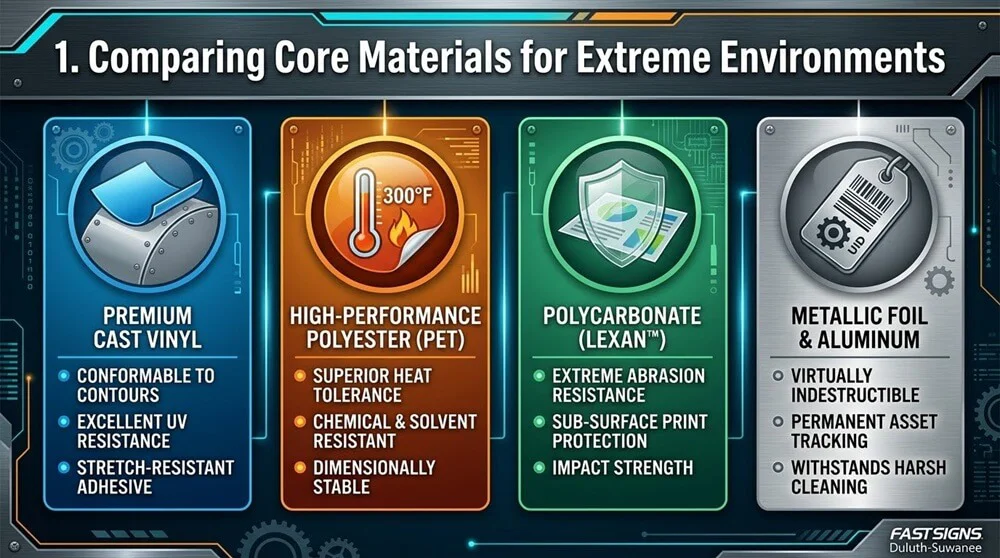
Selecting the right material substrate is the single most critical factor in decal longevity. Below are the four primary industrial-grade substrates used in demanding commercial settings:
Premium Cast Vinyl
Best For: Curved, irregular, or riveted metal surfaces; outdoor machinery, vehicles, and fleet equipment.
Key Strengths: Highly conformable with zero memory pull-back (will not lift out of deep grooves or over rivets). Excellent resistance to UV weathering and temperature fluctuations.
Limitations: Less rigid than polyester or polycarbonate; requires high-performance lamination for heavy solvent exposure.
High-Performance Polyester (PET)
Best For: High-temperature environments, rating plates, asset tracking tags, and chemical processing equipment.
Key Strengths: Exceptional thermal stability (often rated up to 300°F or higher), superior dimensional stability (will not shrink or stretch), and outstanding resistance to solvents, oils, and hydraulic fluids.
Limitations: Rigid structure makes it best suited for flat or gently curved smooth surfaces rather than complex, contoured contours.
Polycarbonate (Lexan™)
Best For: Control panels, overlay graphics, machine touchpoints, and environments exposed to severe impact or continuous rubbing.
Key Strengths: Sub-surface printing allows graphics to be printed on the backside of a transparent polycarbonate sheet. The print layer is completely shielded from abrasion, chemical splashes, and direct contact.
Limitations: Rigid substrate; higher material cost; requires specialized die-cutting for custom shapes.
Anodized Metallic Foil & Aluminum
Best For: Permanent asset tags, barcode labels, UID tags, and engine bay warning graphics.
Key Strengths: Virtually indestructible under extreme heat, direct flame exposure, chemical immersion, and prolonged outdoor exposure.
Limitations: Higher cost per unit; rigid and unyielding surface application.
2. Choosing the Right Protective Overlaminate
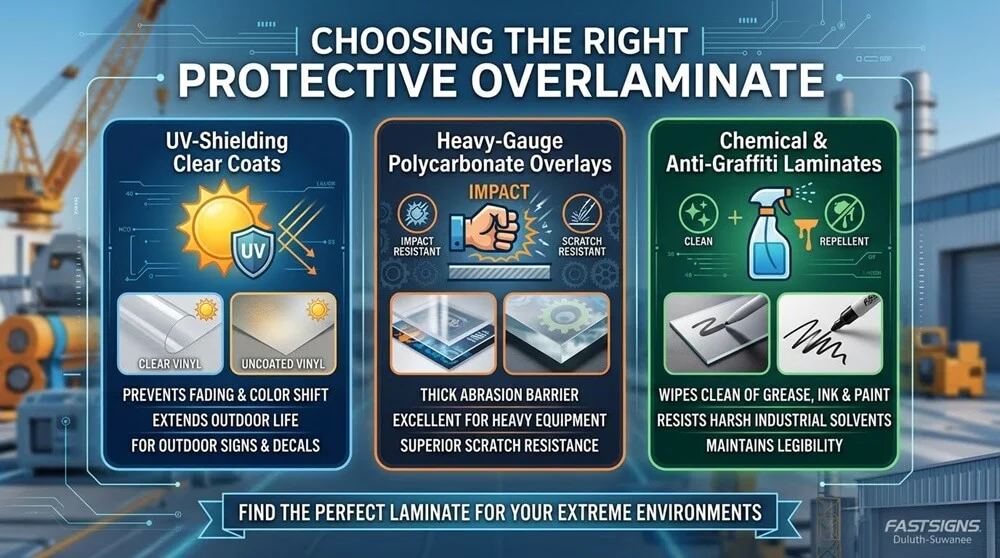
The base material provides structural integrity and ink reception, but the overlaminate provides the primary line of defense against physical and chemical attack.
UV-Shielding Clear Coats: Prevents pigment breakdown and color shifting caused by direct sunlight exposure over multi-year deployments.
Heavy-Gauge Matte or Gloss Polycarbonate Overlays: Adds a thick, scratch-resistant barrier ideal for heavy equipment decals, control buttons, and high-frequency operator touchpoints.
Anti-Graffiti & Chemical-Resistant Laminates: Allows grease, paint, ink, or harsh industrial cleansers to be wiped clean without dulling the underlying graphic.over
3. Environmental Considerations for Commercial Buyers
When specifying custom graphics for machinery, evaluate these four primary environmental stressors:
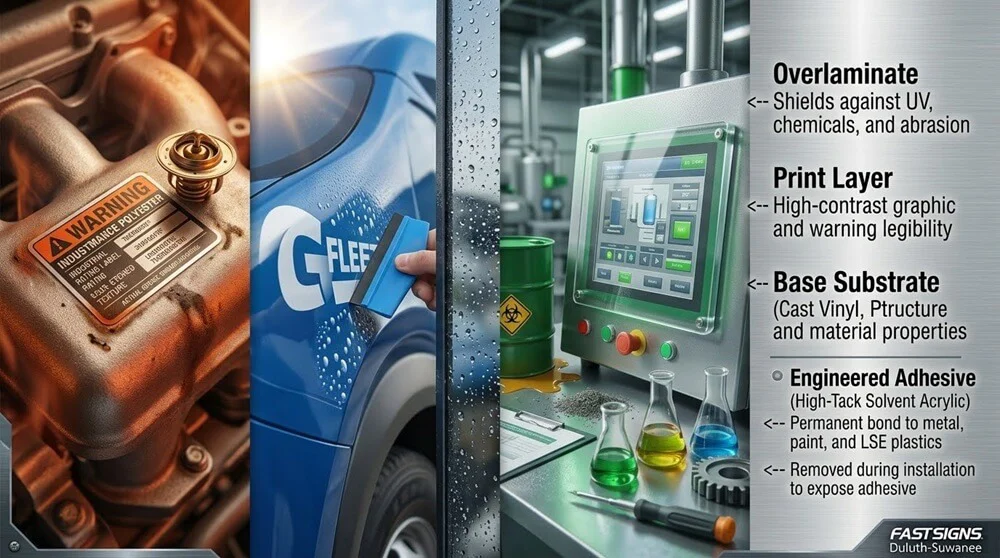
Thermal Extremes & Heat Exposure
Equipment components like engine housings, hydraulic lines, heat exchangers, and exhaust compartments demand heat-resistant decals. Standard adhesives soften and slide when exposed to elevated temperatures. High-heat acrylic adhesives paired with polyester or metallic substrates maintain bond strength at continuous temperatures exceeding 250°F to 300°F.
Weathering & Seasonal Shifts
As outdoor equipment transitions through seasonal weather changes—from intense summer heat and UV exposure to autumn rains and winter freeze-thaw cycles—materials expand and contract. Cast vinyl substrates flex alongside underlying metal bodies, preventing cracking, edge lifting, or moisture intrusion beneath the graphic.
Chemical, Oil & Solvent Contact
In industrial, agricultural, and automotive settings, graphics frequently encounter diesel fuel, hydraulic fluid, industrial degreasers, and battery acid. Specifying chemical-resistant inks and polyester overlaminates ensures warning text remains legible over the machine's lifespan.
Mechanical Abrasion & Impact
Construction machinery, forklifts, and industrial conveyers face ongoing impact from gravel, tools, debris, and operator contact. Durable warning labels engineered with thick polycarbonate overlaminates cushion against direct impacts and scrub clean without sacrificing warning visibility.
Interactive Decision Guide: Selecting the Right Decal Assembly
Use this 4-step checklist to determine the optimal material specification for your upcoming project:
What is the surface composition?
[ ] Smooth painted steel or smooth aluminum Standard or High-Tack Cast Vinyl / PET
[ ] Powder-coated metal or textured plastic High-Tack / LSE Acrylic Adhesive required
[ ] Curved, recessed, or riveted body panel Conformable Premium Cast Vinyl
What temperature ranges will the decal experience?
[ ] Ambient outdoor (-10°F to 120°F) Cast Vinyl or PET
[ ] High heat / near engines (150°F to 300°F+) Polyester (PET) or Metallic Foil with High-Heat Adhesive
What is the primary abrasion level?
[ ] Light (ambient handling, occasional cleaning) Standard Clear Overlaminate
[ ] Heavy (continuous foot traffic, tool scraping, gravel splash) Heavy-Duty Polycarbonate Overlaminate
Will the graphic encounter chemicals or harsh cleaners?
[ ] No direct chemical contact Standard UV Laminate
[ ] Frequent fuel, oil, grease, or solvent washdowns Chemical-Grade PET or Anti-Graffiti Laminate
Consult FASTSIGNS Duluth-Suwanee for Your Custom Decal Projects
Because every equipment application presents a unique combination of surface energy, operating temperature, and environmental exposure, selecting the ideal decal specification requires careful evaluation.
At FASTSIGNS Duluth-Suwanee, our technical graphics team works directly with commercial buyers, OEMs, and facility managers across Duluth, Suwanee, Johns Creek, and Greater Atlanta to engineer custom decal solutions built for the long haul.
Whether you need high-visibility heavy equipment decals, certified durable warning labels, or heat-resistant asset markers, we help you select the exact combination of substrate, ink, laminate, and adhesive for your specific application.
Ready to upgrade your commercial graphics?
Contact FASTSIGNS Duluth-Suwanee Today to request a material sample kit or consult with our custom signage specialists.


