Regulatory Signs, Safety Signs & Custom Accessible Signage in Columbus
Full-Service Compliance Signage From Design Through Installation
Columbus businesses carry real obligations when it comes to posted signage. Federal ADA requirements, OSHA safety signage standards, and local building codes all specify what must be displayed, where, and how. At FASTSIGNS® of Columbus, OH - Downtown, we produce regulatory signs, safety signs, and custom accessible signage and handle every step in between: Graphic Design, Project Management, Survey and Permitting, and Installation. One call covers the whole project.
We’re locally owned and operated, and our 4.9-star Google rating reflects the work we put into every order. When a Columbus client needed compliance signs for a city inspection, they ordered in the morning and picked them up that afternoon. That’s the standard we hold ourselves to.
Ready to get your compliance signage handled? Call us at (614) 467-8450 or request a quote online and we can walk you through what your space requires.
Regulatory & Warning Signs & ADA Signage: What We Produce
Our regulatory and warning signs cover the full range of facility communication: restricted access, no-smoking rules, fire exits, parking requirements, dress codes, and site-specific policies. These signs belong wherever compliance with a law or facility rule must be clearly visible to visitors, employees, and contractors.
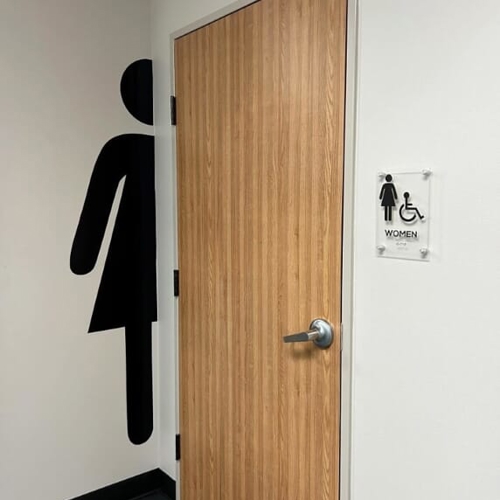
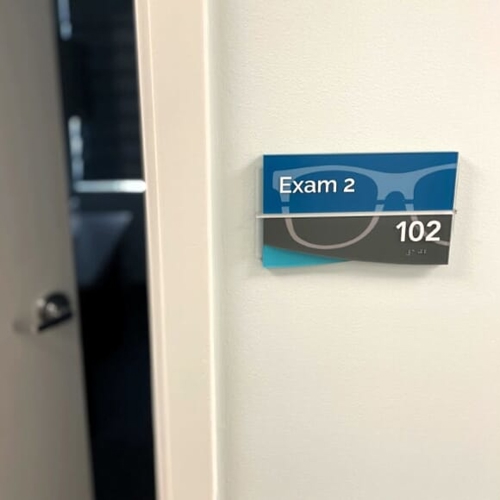
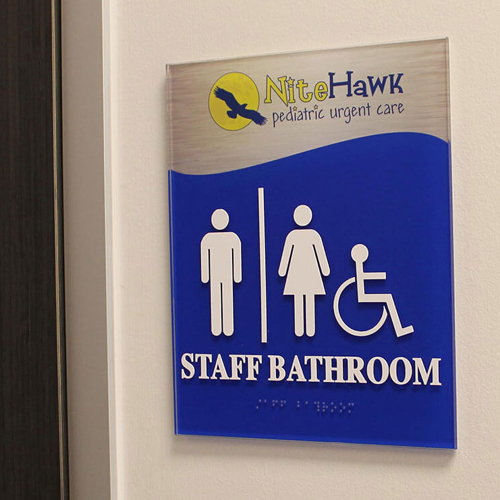
Our custom accessible signage meets ADA standards throughout a property, covering restrooms, conference rooms, stairwells, elevators, fire exits, entryways, and parking areas. Within ADA contrast requirements, these signs can still reflect your brand colors and corporate typeface, so compliance and cohesive design aren’t mutually exclusive.
Signs we regularly produce for Columbus facilities include:
Compliance signs and workplace safety signs for entrances, common areas, and restricted zones
OSHA signage for construction sites and industrial environments
Exit signs, fire exit signs, and emergency exit signs required for egress routes
No-smoking signs and fire extinguisher signs mandated by fire code
Safety directional signs guiding movement through a building or site
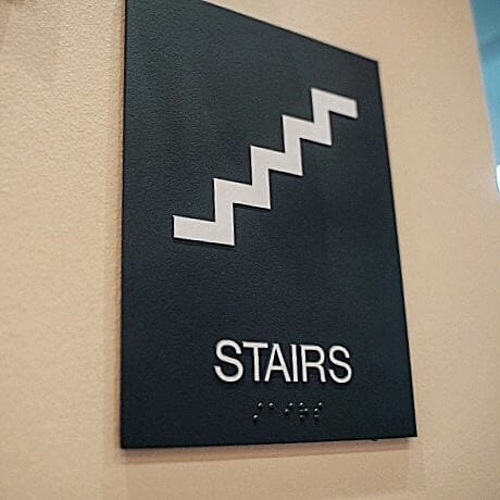
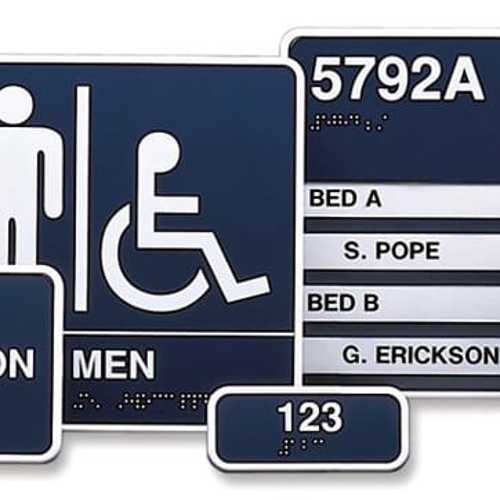
ADA signage with raised tactile characters, Grade 2 Braille, and pictograms
Traffic signs and parking signs for surface lots and structured parking
Why Columbus Businesses Choose FASTSIGNS® of Columbus, OH - Downtown for Compliance Signage
Compliance signage has more moving parts than a standard sign order. A sign produced correctly but mounted at the wrong height or in the wrong location is still non-compliant, which means re-fabrication costs and inspection issues. We remove that risk by keeping everything in-house. Our team handles permitting on your behalf, manages the project timeline, and installs signs to align with placement specifications required by ADA and building code.
Our Graphic Design and Content Development capabilities mean your signs aren’t handed off to a third party at the design stage. From the initial site survey through the final installed sign, FASTSIGNS® of Columbus, OH - Downtown is your single point of contact. New construction and renovation projects in Columbus must have compliant signage in place before final inspection and occupancy permit issuance, and we’re set up to help meet those deadlines.
Start Your Columbus Compliance Signage Project
Whether you’re opening a new location, renovating an existing space, or updating signs to meet current code, FASTSIGNS® of Columbus, OH - Downtown can manage the entire process. We work with offices, healthcare facilities, restaurants, retail stores, property managers, and construction sites throughout Columbus.
Call (614) 467-8450 to discuss your regulatory signs, safety signs, or accessible signage needs. Our team can identify what’s required and build a plan to get it done.
ADA Signage Requirements: What the Standards Specify
The Americans with Disabilities Act of 1990 requires that buildings be accessible to people with disabilities, and signage is a significant part of that obligation. ADA-compliant signs must meet precise standards covering contrast, typography, tactile characters, Braille, pictograms, and placement. Understanding these requirements helps Columbus facility managers plan signage projects accurately.
Visual & Tactile Requirements
ADA signs must display high contrast between background and text colors, and the typeface must be sans serif. All tactile signs must include both raised characters and Grade 2 Braille so people with visual impairments can read by touch. Tactile lettering must be uppercase and between 5/8 inch and 2 inches in height. Braille is placed below the corresponding text (or below the entire text block when text runs multiple lines), with a minimum 3/8-inch separation from any other tactile characters, raised borders, and decorative elements.
When a sign identifies a permanent space and includes a pictogram (a symbol representing a word or concept, such as a wheelchair symbol or restroom gender symbol), tactile text descriptors are also required beneath the pictogram.
Mounting Height & Placement
Placement rules are specific. The baseline of the lowest raised character must sit at least 48 inches above the finished floor; the baseline of the highest raised character must be no more than 60 inches above. ADA signs must be installed on the latch side of the door for the room being labeled and may not be mounted directly on the door, with a limited exception for the push side of doors with closers that don’t have hold-open devices. When wall space at the latch side is insufficient, the sign may be placed on the nearest adjacent wall in a clearly visible location.
Columbus Industries That Commonly Require This Signage
Regulatory, safety, and accessible signage obligations apply across a wide range of Columbus business types. The nature of the space determines which standards apply and how many signs are needed.
Offices and commercial buildings require ADA identification for restrooms, conference rooms, stairwells, and elevators, as well as directional and safety signs throughout common areas
Medical and healthcare facilities carry heightened signage obligations given the number of distinct rooms and the need to support patients with varying disabilities
Retail stores and restaurants must post no-smoking signs, occupancy notices, and ADA-compliant restroom identification
Construction sites require regulatory and warning signs communicating safety protocols, restricted access zones, and required personal protective equipment
Educational institutions need tactile identification for classrooms, administrative offices, restrooms, and exit routes
Multi-tenant commercial buildings and property managers need consistent, code-compliant signage across their entire portfolio as regulations update
New construction projects must have compliant signage installed before final inspection and occupancy permit issuance
How Safety Sign Color & Shape Communicate Meaning
Safety sign design follows an internationally recognized system where color and shape carry specific meaning before a viewer reads a single word. Understanding this system helps facilities choose the right sign for each location.
Red
Indicates prohibition, danger, or emergency action required. Also used for fire equipment signs.
Yellow
Indicates caution or warning of a hazard or risk. Common in areas where care is required but the hazard isn’t immediately life-threatening.
Blue
Indicates mandatory instructions and actions a person must take. Common for personal protective equipment requirements and facility rules.
Green
Indicates safe conditions, positive action, or no danger. Used for exit routes and first-aid locations.
Black and White
Typically used for housekeeping, traffic control, and general information without urgency or hazard association.
Pictograms reinforce these color cues by communicating through universally understood symbols rather than words alone. They’re especially effective in multilingual environments or where reading distance makes text difficult. Safety signs should be large enough to read clearly before someone enters an area of potential hazard. We produce custom safety signs in a variety of sizes and shapes to match the viewing distance and environment of each location.