Introduction
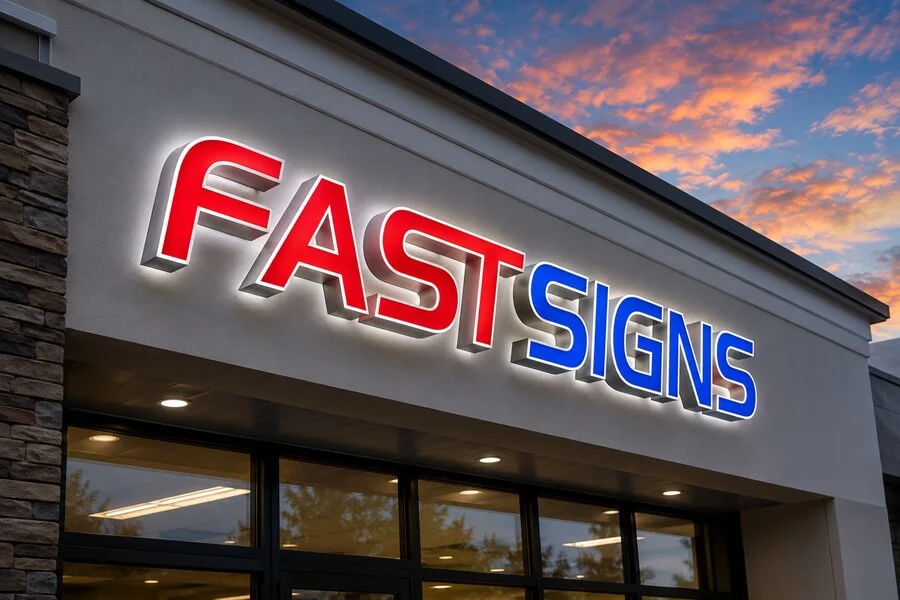
Channel letter signs are one of the most recognizable forms of commercial signage. If you’ve driven through a shopping center, business park, hospital campus, or retail district, you’ve likely seen them mounted above storefronts or office entrances.
A channel letter sign consists of individually fabricated three dimensional letters, numbers, or logos that are typically illuminated with LED lighting. Unlike cabinet signs that enclose all graphics within one large box, each character is built separately, creating a cleaner, more professional appearance.
For many businesses, channel letters offer an effective combination of visibility, durability, and architectural appeal. Factors such as the property’s construction, landlord requirements, local permitting, viewing distance, electrical access, and brand standards all influence whether channel letters are the best choice.
This guide explains how channel letter signs are designed, manufactured, installed, and maintained. It also covers the different types available, when they make sense, when they don’t, and what business owners should understand before investing in one.
Whether you’re opening a new location in Charlotte, North Carolina, renovating an existing storefront, or comparing different exterior sign options, understanding how channel letters work will help you make a more informed decision.
What Are Channel Letter Signs?
A channel letter sign is an exterior sign made from individual three dimensional letters, logos, or symbols that are mounted directly to a building or to a raceway. Each letter is fabricated as its own enclosed structure and is typically illuminated internally using LED modules.
Unlike flat dimensional letters, channel letters contain enough depth to house electrical components and lighting. During the day they provide depth and shadow, while at night the internal illumination allows the sign to remain visible without relying on external floodlights.
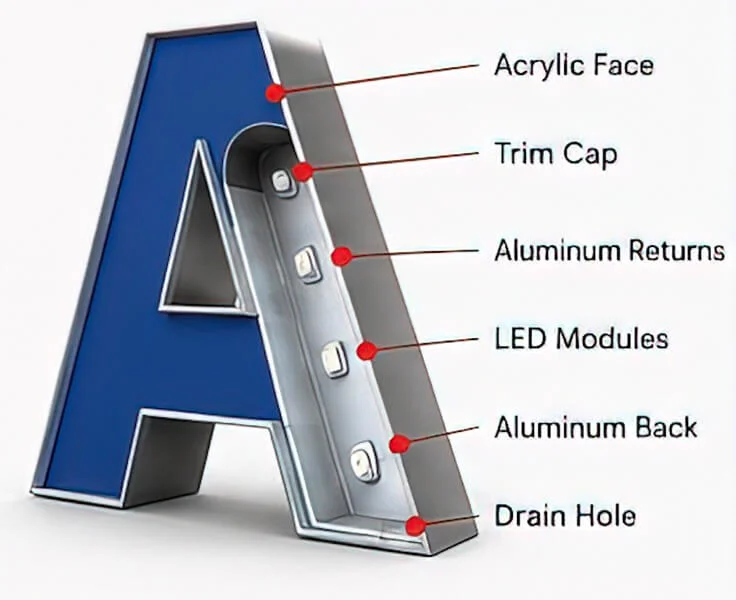
Most commercial channel letters include:
- Aluminum returns (the sides of each letter)
- Aluminum backs
- An acrylic face
- Internal LED lighting
- Electrical wiring and power supplies
- Mounting hardware
Each component serves a specific purpose. Together they create a sign designed for long-term outdoor use in varying weather conditions.
How Do Channel Letter Signs Work?
Channel letters produce light from inside each fabricated letter rather than relying on external lighting fixtures.
Each letter functions almost like a small illuminated box.
Inside every letter are multiple LED modules positioned to distribute light evenly across the acrylic face. These LEDs operate on low-voltage power supplied through transformers or power supplies that convert standard building voltage into the voltage required by the lighting system.
When properly designed, viewers should see:
- Even illumination
- No dark spots
- No bright hotspots
- Consistent color across every letter
- Uniform brightness throughout the sign
Achieving this consistency depends on careful engineering. Letter depth, stroke width, LED spacing, acrylic thickness, and interior reflectivity all affect the final appearance.
This is one reason experienced fabricators rarely use identical lighting layouts for every project. A four-inch-wide letter requires a different LED configuration than a twelve-inch-wide logo element.
The Main Types of Channel Letter Signs
Not all channel letters illuminate the same way. The lighting style affects appearance, readability, maintenance, and overall cost.
Front-Lit Channel Letters
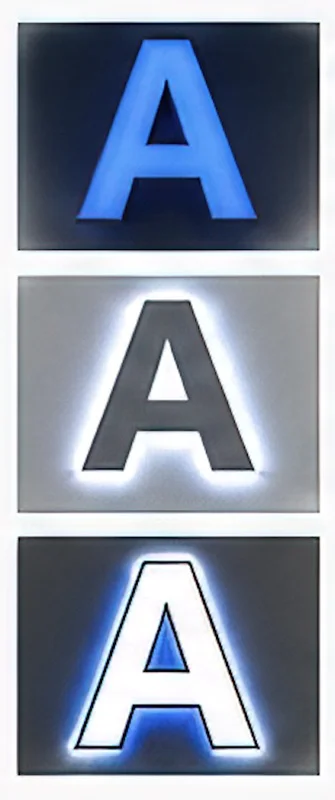
Light shines through the acrylic face while the
aluminum sides and back remain opaque.
Advantages include:
- Excellent daytime visibility
- Strong nighttime brightness
- High readability from longer distances
- Works well for most retail and commercial buildings
- Usually the most economical illuminated option
This style is commonly used for:
- Restaurants
- Retail stores
- Medical offices
- Banks
- Automotive businesses
- Shopping centers
- Grocery stores
For many commercial buildings, front-lit letters are the standard specified by architects and landlords.
Halo-Lit (Reverse-Lit) Channel Letters
Halo-lit letters illuminate the wall behind the sign rather than the face.
Instead of an acrylic face, these letters usually feature metal faces with clear polycarbonate backs spaced slightly away from the wall. Light escapes through the rear of the letters and reflects onto the building surface, creating a soft halo effect.
This produces a refined appearance often associated with:
- Corporate headquarters
- Law firms
- Financial institutions
- Luxury retail
- Hotels
- Class A office buildings
Halo lighting is generally less visible from very long distances but creates a sophisticated architectural look when viewed up close.
Because the wall becomes part of the lighting effect, installation quality and wall condition play a significant role in the finished appearance.
Front and Halo Combination Letters
Some signs illuminate both the face and the rear of the letters.
This style combines the brightness of front-lit letters with the architectural effect of halo lighting.
These signs often require more complex fabrication and electrical planning but can create a distinctive appearance when building design supports it.
Open Face Channel Letters
Open face channel letters expose the lighting source behind a clear face or leave portions of the face open.
Historically, these signs used neon tubing. Today many modern versions use LEDs designed to replicate the appearance of traditional neon.
Open face letters are commonly selected for:
- Restaurants
- Breweries
- Entertainment venues
- Historic districts
- Boutique retail
- Vintage-themed businesses
They create a unique aesthetic but generally require more careful design and may not comply with every landlord’s sign criteria.
Non-Illuminated Channel Letters
Not every channel letter contains lighting.
Some buildings use fabricated metal letters without internal illumination when:
- Exterior lighting already exists
- Municipal regulations restrict illuminated signs
- Budget is limited
- Historic preservation guidelines prohibit lighting
Although they lack nighttime visibility, fabricated metal letters still provide dimensional depth that flat panels cannot.
Where Are Channel Letter Signs Commonly Used?
Channel letters are found across nearly every commercial sector because they balance visibility with architectural appearance.
Common applications include:
Retail Centers
Shopping centers frequently require channel letters as part of tenant sign criteria. Individual letters provide a consistent appearance while allowing each tenant to display its own branding.
Restaurants
Restaurants benefit from visibility during lunch, dinner, and evening hours. Illuminated letters help customers locate entrances after dark.
Office Buildings
Professional offices often choose halo-lit letters to complement modern architectural finishes.
Healthcare Facilities
Hospitals, urgent care centers, medical offices, and specialty clinics use channel letters because they remain readable day and night while presenting a clean appearance.
Schools and Universities
Educational campuses often combine channel letters with monument signs and directional signage to improve campus navigation.
Churches
Many churches install illuminated channel letters on worship centers, family life buildings, and educational facilities.
Industrial Facilities
Manufacturing facilities frequently install large channel letters on warehouse façades where visibility from nearby highways or industrial roads is important.
Hotels
Hotels commonly use illuminated channel letters for primary identification while combining them with monument signs and wayfinding systems throughout the property.
Why Businesses Choose Channel Letter Signs
Channel letters have remained popular for decades because they solve several practical challenges at once.
Strong Visibility
Raised letters create shadows during daylight and maintain visibility after sunset through internal illumination.
Unlike painted wall graphics, channel letters continue performing regardless of changing sunlight throughout the day.
Professional Appearance
Individual fabricated letters integrate with building architecture more naturally than large cabinet signs.
Many newer commercial developments specifically require channel letters because they create a cleaner streetscape.
Long Service Life
Properly fabricated aluminum channel letters resist corrosion and weather far better than many other exterior sign types.
While lighting components eventually require replacement, the structural portions of the sign often remain in service for many years.
Flexible Design Options
Channel letters can accommodate:
- Custom fonts
- Logos
- Brand colors
- Unique shapes
- Various lighting effects
- Multiple mounting methods
This flexibility allows businesses to maintain brand standards while adapting to different buildings.
Energy Efficiency
Modern LED technology consumes significantly less electricity than older neon systems while producing brighter and more consistent illumination.
LED systems also generate less heat and generally require less maintenance over their service life.
Easier Individual Repairs
Because every letter is fabricated separately, damage to one character does not necessarily require replacing the entire sign.
For example, if a vehicle strikes one letter during construction or a single LED power supply fails, repairs can often be limited to the affected section.
This modular design can reduce long-term maintenance costs compared to replacing an entire cabinet sign.
When Channel Letter Signs Are Not the Right Choice
While channel letters are highly versatile, they aren’t the right fit for every business.
- Limited mounting space: Older buildings or façades with windows, trim, or canopies may not support installation.
- Tight budgets: Individually fabricated illuminated letters cost more than panel or cabinet signs.
- Historic districts: Local regulations may restrict illuminated signs, size, colors, or mounting methods. - Temporary locations: Short-term tenants may not recoup the cost of a permanent installation.
- Landlord sign standards: Shopping centers often have strict requirements for letter size, colors, lighting, materials, mounting, and logo placement. Reviewing guidelines early helps avoid costly redesigns.
Choosing the Right Type Starts With the Building
Many people begin by selecting the style of sign they like. In practice, experienced sign professionals usually start somewhere else: the building itself.
The architecture, construction materials, electrical access, local sign ordinances, and landlord requirements often determine which channel letter options are practical long before colors or fonts are discussed.
For example, a halo-lit sign may look impressive in a rendering, but if it will be installed on corrugated metal panels, the uneven surface can distort the lighting effect. Likewise, a shopping center may require all tenants to use front-lit letters mounted on a raceway to maintain a consistent appearance.
The most successful projects balance brand identity with the physical realities of the building. Understanding those factors early helps avoid delays, redesigns, and unexpected costs during permitting and installation.
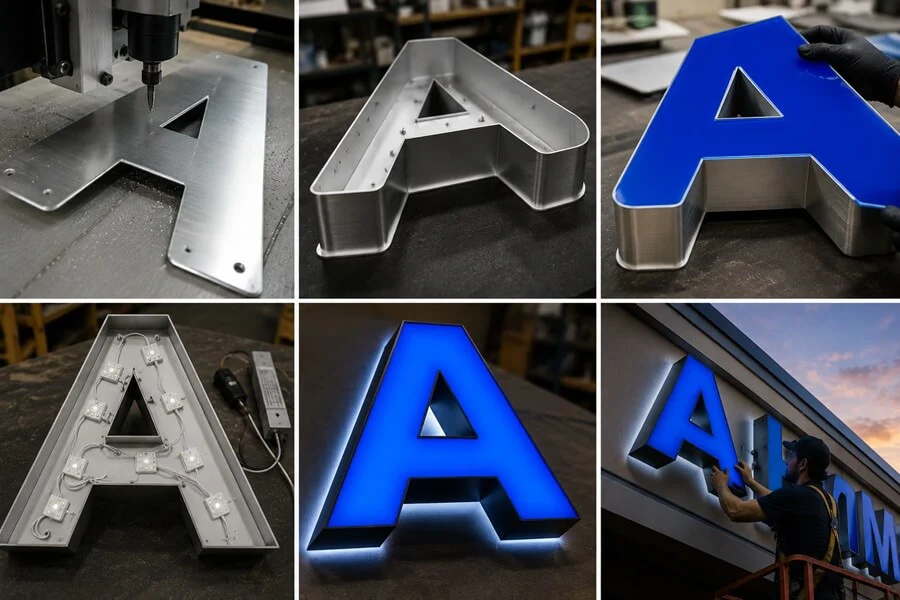
How Channel Letter Signs Are Manufactured
Every custom channel letter sign begins long before fabrication.
The process combines design, engineering, precision manufacturing, electrical planning, and quality control.
Step 1: Site Survey
Before fabrication begins, measurements of the building are confirmed. This typically includes:
- Wall dimensions
- Mounting surface
- Existing electrical access
- Sign placement
- Visibility
- Obstructions
- Landlord sign criteria
Even small measurement errors can lead to costly installation problems.
Step 2: Design and Engineering
Designers prepare production drawings showing:
- Letter sizes
- Font
- Colors
- Illumination type
- Mounting method
- Electrical routing
- Raceway dimensions (if required)
These drawings are often submitted to landlords, architects, municipalities, or permitting departments before fabrication begins
Step 3: CNC Cutting
Modern fabrication relies heavily on CNC routers and laser cutting equipment.
Components such as:
- Aluminum backs
- Acrylic faces
- Mounting patterns
- Logos
are cut with digital precision.
This ensures consistency across every letter.
Step 4: Forming the Returns
The aluminum sides of each letter are bent to match the shape of the design.
Automated channel letter bending equipment allows manufacturers to produce complex fonts with smooth curves and consistent dimensions.
The returns are then attached to the aluminum backs, creating the three-dimensional structure of each letter.
Step 5: Painting and Finishing
Once assembled, letters receive their specified finishes. Common finishes include:
- Standard painted colors
- Satin finishes
- Matte finishes
- Gloss finishes
- Metallic finishes
- Custom brand colors
Proper surface preparation is essential for long-term durability.
Step 6: Installing LEDs
LED modules are positioned inside each letter based on:
- Letter depth
- Stroke width
- Viewing angle
- Brightness requirements
Spacing is carefully calculated to prevent visible hot spots or uneven lighting.
Step 7: Wiring and Testing
Before shipment, every letter is wired and illuminated for testing. Technicians inspect:
- Brightness consistency
- Wiring connections
- Color matching
- Face fit
- Water resistance
- Overall appearance
Testing in the shop helps identify issues before installation begins.
Understanding Mounting Methods
One of the most misunderstood aspects of channel letters is how they are attached to the building.
The mounting method affects appearance, maintenance, installation time, and landlord approval.
Raceway Mounting
A raceway is a painted aluminum box that contains:
- Electrical wiring
- Power supplies
- Mounting hardware
The individual letters are attached to the raceway rather than directly to the building.
Advantages
- Fewer wall penetrations
- Easier installation
- Simpler future maintenance
- Power supplies remain accessible
- Less impact on the building façade
Disadvantages
- The raceway remains visible
- Some architects prefer concealed mounting
- Certain landlords prohibit exposed raceways
Raceways are commonly used in retail centers because they simplify tenant turnover and reduce damage to the building.
Direct Mount (Flush Mount)
With direct mounting, each letter attaches individually to the building.
Electrical wiring passes through the wall behind each letter.
Advantages
- Cleaner architectural appearance
- No visible raceway
- Popular on high-end commercial buildings
Disadvantages
- More wall penetrations
- Installation requires greater precision
- Maintenance may require additional wall access
- Repairs can be more labor-intensive
This method is frequently specified for corporate offices, healthcare facilities, and architect-designed buildings.
Wireway Mounting
A wireway is a smaller version of a raceway.
Instead of housing power supplies, it primarily conceals wiring while reducing the number of wall penetrations.
Because it is much narrower than a raceway, it is less noticeable from ground level.
Electrical Requirements
Channel letter signs require more than simply connecting to an electrical outlet.
A properly designed installation considers:
- Available circuits
- Disconnect location
- Electrical code compliance
- Access for servicing
- Voltage requirements
- Weather protection
Electrical work is typically performed by licensed electricians in accordance with local codes.
In North Carolina, commercial electrical work often requires permits and inspections depending on the project scope.
Permitting in Charlotte, North Carolina
Most permanent exterior signs require approval before installation.
Depending on the municipality, this process may involve:
- Sign permit applications
- Construction drawings
- Electrical permits
- Structural calculations
- Landlord approval
- Planning department review
Within Charlotte and surrounding communities such as Huntersville, Cornelius, Matthews, Pineville, and Concord, permitting requirements can vary based on local ordinances and zoning regulations.
Starting fabrication before permits are approved can lead to costly delays if revisions are required.
Landlord and Property Management Requirements
For businesses located in shopping centers or office developments, the landlord’s sign criteria are often just as important as municipal regulations.
Typical requirements may specify:
- Maximum letter height
- Approved fonts
- Logo placement
- Illumination color
- Raceway color
- Mounting method
- Building locations where signs are permitted
Experienced sign companies review these criteria early in the design process to avoid redesigns later.
Installation Process
Installing channel letters requires coordination between fabricators, installers, electricians, and sometimes crane operators.
While every project is different, the process generally follows the same sequence.
Step 1: Verify the Site
Before installation begins, the crew confirms:
- Building dimensions
- Mounting surface
- Electrical availability
- Equipment access
- Final sign location
Any discrepancies are addressed before holes are drilled into the building.
Step 2: Layout
A full-size installation pattern is taped or temporarily fastened to the wall.
This pattern identifies the exact location of every letter and every mounting hole.
Taking time during layout helps ensure the finished sign appears level and properly centered.
Step 3: Mount the Raceway or Letters
Depending on the approved mounting method, installers either:
- Secure the raceway to the building, or
- Mount each individual letter directly to the wall.
Care is taken to maintain consistent spacing and alignment.
Step 4: Complete Electrical Connections
Power supplies are connected and tested.
Installers verify:
- Even illumination
- Proper operation
- Secure wiring
- Weatherproof seals
Step 5: Final Inspection
Before leaving the site, the installation team inspects:
- Letter alignment
- Brightness
- Mounting hardware
- Sealants
- Electrical operation
- Overall appearance from multiple viewing angles
A final inspection often reveals small adjustments that improve the finished presentation.
How Long Do Channel Letter Signs Last?
The structural components of a professionally fabricated channel letter sign often remain in service for 15 to 20 years or more.
However, not every component has the same lifespan.
Typical expectations include:
- Aluminum letter bodies: 15–25+ years
- Acrylic faces: 10–20 years depending on UV exposure
- LED modules: Often 7–15 years, depending on usage and quality
- Power supplies: Commonly replaced once or more during the sign’s life
- Paint finishes: Vary based on sun exposure, orientation, and environmental conditions
Signs exposed to direct afternoon sun, heavy traffic pollution, or coastal environments may require cosmetic maintenance sooner than those installed in more protected locations.
Maintenance Requirements
One advantage of channel letters is that they generally require relatively little routine maintenance.
Even so, periodic inspections can extend the life of the sign and prevent small issues from becoming costly repairs.
Recommended maintenance includes:
- Cleaning dirt and pollen from the faces
- Inspecting for water intrusion
- Checking sealants
- Looking for loose trim caps
- Verifying even illumination
- Replacing failed LED modules promptly
- Inspecting power supplies during service calls
In the Charlotte area, spring pollen and seasonal storms can leave residue on illuminated signs. Cleaning the sign periodically helps maintain brightness and preserves its appearance without the need for major repairs.
Routine maintenance is especially important for businesses that operate after dark, as burned-out letters or inconsistent illumination can make a business appear closed even when it is open.
What Determines the Cost of a Channel Letter Sign?
One of the first questions business owners ask is, “How much does a channel letter sign cost?” The honest answer is that there is no standard price because every sign is custom manufactured for a specific building, brand, and set of requirements.
Unlike products that are mass-produced, channel letters are engineered for each project. Two signs that appear similar from the street can have very different fabrication costs based on size, materials, installation complexity, and permitting requirements.
Understanding what drives the cost helps you compare quotes more effectively and avoid making decisions based solely on the lowest price.
1. Letter Size
Larger letters require:
- More aluminum
- More acrylic
- More LED modules
- Larger power supplies
- More labor during fabrication
- Additional shipping and handling
A sign with 36-inch letters typically costs considerably more than one with 18-inch letters—not simply because it uses more material, but because larger letters often require additional structural reinforcement and more installation time.
2. Number of Letters and Logo Complexity
The overall size of the sign is only one factor.
A business name like ABC Dental requires far fewer fabricated components than Charlotte Regional Orthopedic Specialists, even if both signs span the same width.
Custom logos also increase fabrication time, especially when they include:
- Multiple colors
- Intricate curves
- Thin strokes
- Layered elements
- Push-through acrylic
- Separate illuminated sections
Every additional piece adds manufacturing and assembly time.
3. Type of Illumination
Not all illuminated channel letters are built the same.
Generally, fabrication becomes more complex as lighting effects become more sophisticated.
For example:
- Front-lit letters are usually the most straightforward to manufacture.
- Halo-lit letters require careful spacing from the wall to produce an even glow.
- Combination front-and-halo-lit letters involve additional engineering, wiring, and fabrication.
- Open-face letters often require specialty components and more detailed assembly.
The lighting style should be selected based on the building and brand— not simply because one option appears more expensive or more modern.
4. Mounting Method
The method used to install the letters also affects project cost.
Raceway-mounted signs generally install more quickly because most wiring is contained within a single aluminum enclosure.
Direct-mounted letters often require:
- More wall penetrations
- More precise layout
- Additional drilling
- Longer installation time
- More detailed electrical routing
Although direct mounting creates a cleaner appearance, it usually requires more labor during installation.
5. Building Conditions
No two buildings present the same installation challenges. Factors that increase installation complexity include:
- Multi-story buildings
- Limited equipment access
- Brick or stone façades
- Uneven surfaces
- Existing architectural features
- Canopies
- Restricted working hours
- Busy pedestrian areas
For example, installing a sign above a storefront in a shopping center is typically less complex than mounting letters on the fourth floor of an office building where cranes or specialized lifts are required.
6. Electrical Work
Many customers assume the sign company handles all electrical work, but requirements vary by jurisdiction and project.
Additional costs may arise if:
- A new electrical circuit is required
- Existing wiring must be relocated
- Disconnect switches must be installed
- Long conduit runs are necessary
- Electrical permits are required
If electrical infrastructure is not already available near the sign location, the total project cost can increase significantly.
7. Permits and Engineering
Most permanent exterior signs require permits before installation. Depending on the municipality, projects may require:
- Sign permits
- Electrical permits
- Structural calculations
- Engineered drawings
- Landlord approvals
- Historic district review
These administrative requirements are often overlooked during early budgeting but can represent a meaningful portion of the overall project timeline and cost.
8. Installation Equipment
Some installations require little more than ladders.
Others may require:
- Bucket trucks
- Scissor lifts
- Boom lifts
- Cranes
- Street closures
- Traffic control
- After-hours installation
Equipment rental and labor can vary substantially depending on site conditions.
Why the Lowest Quote Isn’t Always the Best Value
When comparing proposals, it’s important to understand exactly what is included.
Two quotes may differ because one includes:
- Permitting
- Engineering
- Installation
- Electrical connections
- Removal of an existing sign
- Warranty coverage
- Premium LED components
while another may exclude several of those items.
Instead of asking only, “Which quote is cheaper?” ask:
- What materials are being used?
- Which LED manufacturer is specified?
- Is permitting included?
- Is installation included?
- Is electrical work included?
- How long is the warranty?
- Who services the sign if something fails?
Comparing scope—not just price—usually provides a clearer picture of long-term value.
Channel Letters vs. Other Common Commercial Sign Types
Channel letters are one of several options available for exterior building identification. Understanding how they compare with other sign types can help determine which solution best fits your property.
Channel Letters vs. Cabinet Signs
Cabinet signs consist of a single illuminated box with graphics applied to the face.
Channel Letters
Advantages
- More architectural appearance
- Individual three-dimensional letters
- Often required by modern shopping centers
- Easier to repair individual letters
- Greater design flexibility
Limitations
- Higher initial investment
- More fabrication time
- More complex installation
Cabinet Signs
Advantages
- Often lower initial cost
- Large graphic area
- Suitable for businesses needing multiple messages
- Simpler construction
Limitations
- Less dimensional appearance
- Larger visible sign cabinet
- Individual letters cannot usually be replaced independently
Many older retail centers still use cabinet signs, while newer developments increasingly specify channel letters for aesthetic consistency.
Channel Letters vs. Flat Cut (Dimensional) Letters
Dimensional letters are solid letters cut from materials such as aluminum, acrylic, PVC, or foam.
Channel Letters
- Internally illuminated
- Greater nighttime visibility
- More depth
- Designed for long-distance recognition
Dimensional Letters
- Typically non-illuminated
- Lower cost
- Suitable for interior branding
- Common for office lobbies and monument signs
If nighttime visibility is important, illuminated channel letters generally provide a significant advantage.
Channel Letters vs. Monument Signs
These products often complement one another rather than compete.
A monument sign identifies the property from the street. Channel letters identify the individual tenant or business on the building.
Many commercial developments use both because they serve different viewing distances.
Channel Letters vs. Blade Signs
Blade signs project perpendicular from the building, allowing pedestrians walking along sidewalks to see the business before reaching the storefront.
Channel letters primarily face vehicle traffic and customers approaching directly.
Urban retail districts frequently use both sign types together.
Channel Letters vs. Neon Signs
Although neon remains popular for certain applications, LEDs have replaced neon for most commercial channel letters.
LEDs
- Lower energy consumption
- Longer operating life
- Lower maintenance
- Greater durability
- No fragile glass tubing
Neon
- Distinct visual character
- Excellent for vintage aesthetics
- More specialized maintenance
- Higher energy consumption
- Greater risk of breakage
For most modern commercial buildings, LED channel letters have become the standard choice.
Common Mistakes Businesses Make When Buying Channel Letter Signs
After years of working with commercial signage projects, certain issues appear repeatedly. Many are preventable with proper planning.
Waiting Too Long
Exterior signs are often one of the last items considered during a new business opening.
In reality, permitting, landlord approvals, fabrication, and installation can take several weeks—or longer for more complex projects.
Waiting until just before opening day often results in unnecessary delays.
Choosing a Sign Before Understanding Building Requirements
Many business owners select a sign style they like before reviewing:
- Landlord criteria
- Local sign ordinances
- Architectural limitations
- Electrical access
This can lead to redesigns and additional expense.
Starting with the building requirements usually produces a smoother project.
Prioritizing Price Over Visibility
A smaller sign may reduce the initial investment, but it can also reduce visibility from the roadway.
An undersized sign is difficult to correct after fabrication.
Letter size should be based on viewing distance, traffic speed, and available façade space—not solely on budget.
Ignoring Future Maintenance
Power supplies, access panels, and mounting methods all affect future serviceability.
Signs that are difficult to access may cost more to maintain over their lifetime.
Considering maintenance during the design stage can reduce long-term ownership costs.
Overcomplicating the Design
One of the most common design mistakes is trying to include too much information.
Business names, taglines, multiple phone numbers, websites, and unnecessary graphics reduce readability.
For most exterior signs, simpler designs are easier to recognize— especially from moving vehicles.
Failing to Match the Building
An attractive sign can still feel out of place if it doesn’t complement the architecture.
Materials, lighting style, and colors should work with the building rather than compete with it.
For example, a polished halo-lit sign may enhance a contemporary office building, while bold front-lit letters may be more appropriate for a retail storefront with heavy vehicle traffic.
The most successful channel letter signs don’t just display a business name—they integrate with the building, remain legible under varying conditions, and continue performing for many years with minimal maintenance. Choosing the right materials, installation method, and design from the outset almost always results in a better long-term investment than focusing only on the initial purchase price.
Expert Buyer’s Checklist
Before approving the design or signing a proposal, review the following items. Addressing these questions early can help prevent delays, change orders, or unexpected costs later in the project.
✓ Have you reviewed your landlord’s sign criteria?
Many shopping centers and office developments have detailed sign standards covering:
- Maximum letter height
- Approved colors
- Illumination type
- Mounting method
- Raceway requirements
- Logo placement
Never assume your sign can be fabricated exactly as your brand guidelines show it. Verify what the property allows before finalizing the design.
✓ Is the sign sized for the viewing distance?
A sign should be designed based on where it will be seen—not simply based on the available wall space.
Consider:
- Vehicle speed
- Distance from the road
- Building setbacks
- Nearby trees
- Parking lot layout
- Existing lighting
- Competing storefronts
A sign that looks large on a computer screen may appear surprisingly small once installed on a commercial building.
✓ Is the lighting appropriate for the building?
Front-lit, halo-lit, and combination-lit letters each create a different impression.
Choose the lighting style that complements the building’s architecture and the way customers approach the business.
✓ Have future service needs been considered?
Ask where the power supplies will be located.
Accessible electrical components make future maintenance faster and less disruptive.
✓ Are the materials specified?
Your proposal should identify key materials, including:
- Aluminum construction
- Acrylic face type
- LED manufacturer (when specified)
- Paint finish
- Mounting method
- Warranty coverage
A detailed proposal makes it easier to compare contractors fairly.
✓ Has permitting been discussed?
Confirm who is responsible for:
- Sign permits
- Electrical permits
- Landlord approval
- Engineering documents
- Inspections
Clarifying responsibilities early helps avoid project delays.
Frequently Asked Questions
1. How long do channel letter signs last?
The aluminum structure of a professionally fabricated channel letter sign often lasts 15 to 25 years or more. LED modules, power supplies, paint finishes, and acrylic faces have different service lives and may require replacement before the sign structure itself.
2. Are channel letters waterproof?
Yes. Exterior channel letters are designed for outdoor use and include sealed construction to help prevent water intrusion. Proper fabrication, drainage, and installation are essential to long-term performance.
3. Do channel letters use a lot of electricity?
No. Modern LED channel letters are relatively energy efficient compared to older neon systems and generally consume far less electricity than many people expect. Actual usage depends on the size of the sign, operating hours, and the number of illuminated letters.
4. Can individual letters be repaired?
In many cases, yes.
One advantage of channel letters is that individual letters can often be serviced or replaced without replacing the entire sign.
5. Do I need a permit?
Most permanent exterior channel letter signs require permits before installation. Requirements vary by municipality and may also include landlord approval, electrical permits, or engineering documents.
6. What’s the difference between a raceway and direct mounting?
A raceway houses the wiring and mounting hardware inside a painted aluminum enclosure attached to the building. Direct mounting attaches each letter individually to the wall, creating a cleaner appearance but requiring more wall penetrations and often more installation time.
7. Can channel letters be installed on any building?
Not always.
The building’s construction, façade materials, structural conditions, electrical access, landlord requirements, and local sign ordinances all influence whether channel letters are appropriate.
8. Are channel letters brighter than cabinet signs?
Not necessarily.
Brightness depends on the lighting design rather than the sign type. Properly engineered LED systems can provide excellent visibility in both cabinet signs and channel letters.
9. Can logos be fabricated as channel letters?
Yes.
Many channel letter projects include custom logos, symbols, and graphic elements in addition to individual letters. Complex logos may require specialized fabrication techniques depending on their shape and lighting requirements.
10. How often should channel letters be cleaned?
Most commercial buildings benefit from cleaning at least once or twice each year. In areas like Charlotte, pollen, dust, road debris, and seasonal storms can reduce the appearance of illuminated signs over time.
11. What happens if one letter stops lighting?
The cause may be a failed LED module, power supply, wiring issue, or electrical connection. In many cases, only the affected letter—or even a portion of that letter—requires repair.
12. Can I replace a neon sign with LED channel letters?
Yes, in many situations. Replacing aging neon with LED channel letters can reduce maintenance and energy use while improving reliability. However, the building, electrical system, and local regulations should be evaluated before making the change.
13. Are channel letters suitable for historic buildings?
Sometimes. Historic districts often have additional design and permitting requirements. Some projects may require non-illuminated letters or alternative lighting methods to comply with preservation guidelines.
14. How long does the process usually take?
The timeline depends on the project’s complexity, permitting requirements, landlord review, fabrication schedule, and installation conditions. Simple projects may move quickly, while larger or more regulated installations can take considerably longer.
15. Are channel letters worth the investment?
For many permanent commercial locations, channel letters provide durable identification, strong visibility, and an appearance that complements modern commercial architecture. Whether they are the right investment depends on the building, business goals, lease term, and local requirements.
Final Thoughts and Key Takeaways
Channel letter signs have become the standard for commercial building identification because they combine durability, visibility, and architectural appeal. Their popularity, however, does not mean they are the right solution for every property.
The most successful projects begin with a clear understanding of the building, local regulations, landlord requirements, and how customers will view the sign. Decisions about lighting style, mounting method, materials, and letter size should support those practical considerations rather than follow trends.
Business owners should also remember that a channel letter sign is a long-term investment. A well-designed sign can remain in service for many years, while thoughtful planning during the design and permitting stages can reduce maintenance issues and avoid unnecessary delays.
Whether you’re opening a new storefront, renovating an existing property, or updating an older sign, understanding how channel letters are built and installed allows you to evaluate proposals more confidently and choose a solution that fits both your building and your business.
- Channel letters are individually fabricated, three-dimensional signs that are typically illuminated with LEDs, offering a clean and architectural appearance.
- The best sign depends on the building, viewing distance, local regulations, and business needs.
- Careful planning regarding permits, landlord criteria, and local weather conditions helps reduce delays and maintenance issues.

