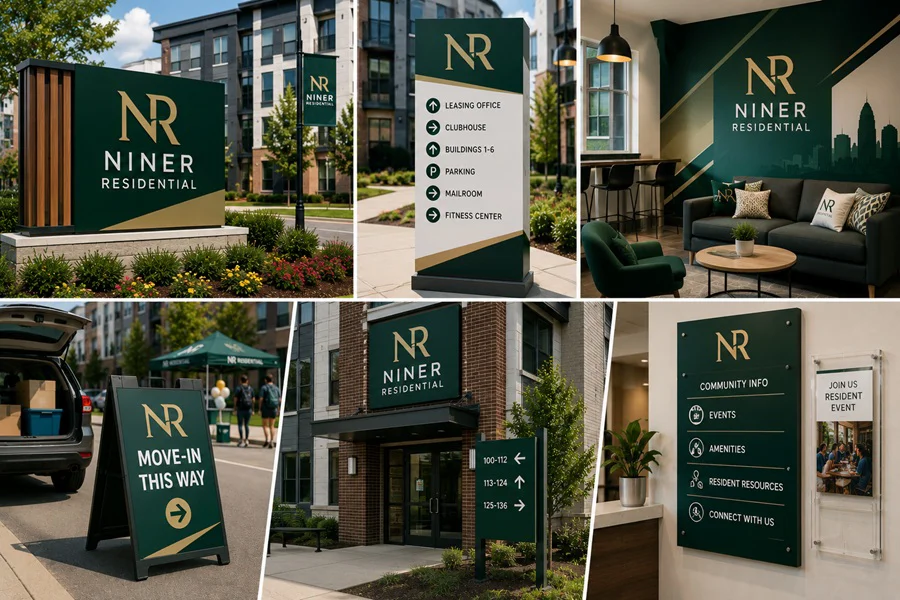
Introduction
Student housing communities have many of the same signage needs as conventional apartment complexes, but they also face a unique set of operational challenges. Frequent resident turnover, first-time renters, move-in logistics, visitor traffic, campus proximity, and a younger demographic all influence how signage should be designed, installed, and maintained.
Whether serving students at the University of North Carolina at Charlotte (UNC Charlotte), nearby community colleges, or other higher education institutions, student housing requires signage that emphasizes navigation, durability, branding, and flexibility. Unlike traditional multifamily properties, where residents may stay for several years, student housing often experiences nearly complete resident turnover every academic year.
For apartment owners and property managers throughout Charlotte, North Carolina, understanding these differences can improve resident experiences while reducing confusion, maintenance, and operational costs.
What Makes Student Housing Different?
Student housing includes apartment communities built specifically for college and university students. While many resemble conventional apartment complexes, they typically experience significantly higher traffic, more frequent leasing cycles, and larger numbers of first-time visitors.
Student housing often includes:
- Individual bedroom leases
- Multiple roommates
- Frequent visitors
- Resident events
- Package lockers
- Study lounges
- Fitness centers
- Shuttle stops
- Leasing offices
- Parking management
These operational differences create unique signage requirements throughout the property.
Why Signage Matters More in Student Housing
Unlike conventional apartment communities, student housing constantly welcomes new residents who have never lived on the property.
During move-in season, hundreds of students and families may arrive over a single weekend.
Without effective signage, common problems include:
- Traffic congestion
- Residents entering incorrect buildings
- Confusion during check-in
- Parking issues
- Increased staff interruptions
- Delayed move-ins
Well-planned signage helps reduce these challenges while creating a more organized first impression.
Higher Resident Turnover Requires More Flexible Signage
One of the biggest differences between student housing and conventional apartments is turnover.
Traditional apartments often have residents who remain for several years.
Student housing may replace nearly every resident annually.
This means property managers frequently update:
- Office hours
- Leasing information
- Parking instructions
- Event schedules
- Resident notices
- Building access information
Flexible signage systems make these updates easier and less expensive.
Examples include:
- Changeable message boards
- Snap-frame poster holders
- Digital displays
- Replaceable inserts
- Modular directories
These solutions reduce the need to manufacture entirely new signs each semester.
Wayfinding Is More Important Than Many Realize
Student housing often consists of multiple buildings spread across large properties.
New residents may arrive late at night after traveling long distances.
Visitors frequently include:
- Parents
- Delivery drivers
- Friends
- Maintenance contractors
- Food delivery services
- Rideshare drivers
Effective wayfinding should clearly identify:
- Building numbers
- Parking areas
- Leasing office
- Clubhouse
- Mailroom
- Package lockers
- Fitness center
- Pool
- Study spaces
- Trash and recycling areas
Consistent directional signage reduces unnecessary vehicle circulation and improves traffic flow throughout the property.
Branding Plays a Different Role
Traditional apartment branding often focuses on luxury amenities or neighborhood appeal.
Student housing branding typically emphasizes:
- Campus lifestyle
- Community
- Academic success
- School spirit
- Social engagement
Environmental graphics may feature:
- Study spaces
- Campus-inspired artwork
- Local landmarks
- School colors (when permitted)
- Community events
- Resident success stories
The objective is creating an environment students enjoy while avoiding visual clutter.
Move-In and Move-Out Signage Is Critical
Few apartment communities experience the logistical demands of student move-in weekends.
Temporary signage often includes:
- Vehicle routes
- Unloading zones
- Check-in stations
- Elevator assignments
- Parking instructions
- Building entrances
- Resident registration
Planning these signs well in advance improves efficiency while reducing frustration for residents and staff.
Temporary signs should be designed for annual reuse whenever possible.
Package Delivery Has Become a Major Signage Need
Student housing receives large volumes of package deliveries throughout the year.
Signage should clearly identify:
- Package lockers
- Mailrooms
- Pickup procedures
- Delivery entrances
- Resident access hours
Clear signage benefits both residents and delivery drivers while reducing unnecessary trips to the leasing office.
Amenity Signage Receives Heavy Daily Use
Student housing amenities often experience greater use than conventional apartment communities.
Common amenities include:
- Fitness centers
- Gaming rooms
- Study lounges
- Coffee bars
- Outdoor gathering spaces
- Pools
- Clubhouses
- Computer labs
Signs should communicate:
- Hours
- Rules
- Reservation procedures
- Emergency contacts
- Accessibility information
Durable materials are especially important in high-traffic environments.
Material Options for Student Housing Signage
Aluminum
Commonly used for:
- Parking signs
- Traffic signs
- Building identification
Advantages include corrosion resistance and long service life.
ACM (Aluminum Composite Material)
Frequently selected for:
- Monument signs
- Directional signs
- Entrance features
Advantages include durability and a professional appearance with relatively low maintenance.
Acrylic
Suitable for:
- Office directories
- Interior identification
- Amenity signs
- Donor recognition
Provides a clean appearance while allowing multiple mounting options.
Vinyl Graphics
Ideal for:
- Leasing offices
- Windows
- Walls
- Seasonal promotions
- Temporary campaigns
Vinyl offers flexibility but may require replacement more often than rigid materials.
Reflective Materials
Reflective graphics improve nighttime visibility for:
- Parking signs
- Building numbers
- Emergency information
- Traffic control
This is particularly valuable because students often arrive and travel after dark.
Design Considerations
Prioritize Readability
Students and visitors often make decisions while walking or driving.
Signs should use:
- Large lettering
- High color contrast
- Simple icons
- Minimal wording
Complex signs slow decision-making and increase confusion.
Maintain Consistency
Every sign should follow the same design standards.
Consistency includes:
- Typography
- Colors
- Icons
- Materials
- Mounting methods
Visitors quickly learn how to interpret signs when the visual language remains consistent.
Design for Durability
Student housing experiences:
- Frequent deliveries
- Heavy pedestrian traffic
- Outdoor events
- Weather exposure
- Increased maintenance activity
Choosing durable materials reduces repair and replacement costs over time.
Common Mistakes
Underestimating Temporary Signage
Move-in weekends often require dozens of temporary signs.
Failing to plan ahead creates confusion that permanent signs cannot solve.
Poor Building Number Visibility
Building numbers should remain visible from approaching roads, parking lots, and sidewalks.
Hidden building numbers increase response times for emergency services and delivery drivers.
Inconsistent Branding
Replacing signs individually over several years can create mismatched fonts, colors, and materials.
Developing signage standards helps maintain a cohesive appearance as the property evolves.
Forgetting Visitor Navigation
Most visitors have never been to the property.
Directional signs should guide first-time visitors—not just residents.
Maintenance Considerations
Student housing signs experience frequent use and should be inspected regularly for:
- Faded graphics
- Damaged panels
- Loose hardware
- Graffiti
- Lighting failures
- Missing directional signs
Annual inspections before the academic year begins can identify issues before thousands of students return to campus.
Temporary move-in signage should also be cleaned, inventoried, and stored properly for reuse.
Student Housing Signage in Charlotte
Charlotte continues to see growth in higher education, with institutions such as the University of North Carolina at Charlotte and nearby colleges driving demand for student-oriented housing. Apartment communities serving these campuses often require signage systems that support annual move-ins, visitor navigation, campus events, and a dynamic resident population.
Because many student housing properties are located near busy roads, retail centers, and mixed-use developments, well-planned monument signs, directional signage, parking identification, and environmental graphics help create a safer and more organized experience for residents and guests alike.
Frequently Asked Questions
How is student housing signage different from regular apartment signage?
Student housing typically requires more temporary signage, stronger wayfinding, frequent information updates, and materials designed to withstand heavier use due to annual resident turnover.
Why is wayfinding especially important in student housing?
Many residents and visitors are unfamiliar with the property, particularly during move-in weekends. Clear wayfinding reduces congestion, improves safety, and minimizes confusion.
What materials work well for outdoor student housing signage?
Aluminum, ACM panels, reflective graphics, and durable vinyl are commonly used because they perform well outdoors and require relatively little maintenance.
Should student housing use digital signage?
Digital displays can be useful in leasing offices, clubhouses, and resident common areas where announcements, event schedules, and reminders change frequently. However, they require ongoing content management and should complement—not replace—permanent directional signage.
How often should student housing signage be updated?
Permanent signs should be inspected annually and updated as buildings or amenities change. Temporary event and move-in signage should be reviewed before each academic year to ensure it remains accurate and in good condition.
Can student housing signage incorporate university branding?
When permitted through licensing agreements, signage and environmental graphics may reflect school colors or campus-inspired themes. Properties should avoid using protected university logos or trademarks without proper authorization.
Conclusion
Student housing signage serves a broader purpose than simply identifying buildings. It supports move-in logistics, improves navigation, enhances resident communication, and creates an organized environment for students, families, staff, and visitors.
The most effective signage programs combine durable materials, consistent branding, flexible temporary signage, and intuitive wayfinding. By planning for annual turnover, high visitor volumes, and changing campus needs, property owners and managers can create signage systems that remain functional and cost-effective for years to come.

