Understanding ADA Signage Requirements
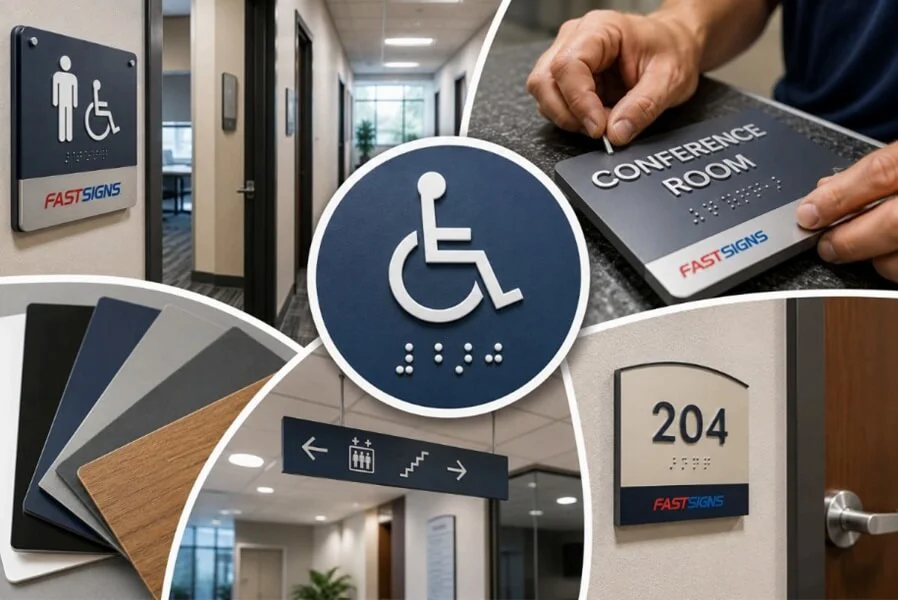
If your business has permanent rooms, offices, restrooms, exits, stairwells, or other spaces that the public or employees use, there’s a good chance ADA-compliant signage is required by law.
The Americans with Disabilities Act (ADA) established accessibility standards to ensure people with disabilities can navigate buildings independently and safely. While many people associate the ADA with wheelchair ramps and accessible parking, interior signage is an equally important part of accessibility. ADA signs are not simply signs with Braille. They must meet strict requirements for lettering, tactile characters, mounting height, contrast, placement, and, in many cases, the inclusion of Grade 2 Braille.
Understanding when ADA signs are required—and when they are not—can help building owners avoid costly mistakes, failed inspections, and accessibility complaints. Whether you’re opening a new business in Charlotte, renovating an office, building a medical facility, or managing a commercial property, knowing the basics of ADA signage is essential.
What Is an ADA Sign?
An ADA sign is a sign designed to comply with the accessibility standards established under the Americans with Disabilities Act.
These standards allow individuals with visual impairments, blindness, or limited mobility to identify permanent rooms and navigate buildings more independently.
Most ADA signs include:
- Raised tactile lettering
- Grade 2 Braille
- High color contrast
- Non-glare finish
- Proper mounting location
- Specific character sizing and spacing
Not every commercial sign must comply with ADA tactile requirements. The rules depend on the sign’s purpose, where it is installed, and whether it identifies a permanent location.
This distinction is one of the most common sources of confusion for business owners.
What Does ADA Stand For?
ADA stands for the Americans with Disabilities Act, a federal civil rights law signed in 1990.
Its purpose is to prohibit discrimination against individuals with disabilities and establish minimum accessibility standards for public accommodations, commercial facilities, government buildings, transportation, and employment.
For signage, ADA requirements are primarily found within the 2010 ADA Standards for Accessible Design, which specify how permanent room identification signs must be designed and installed.
It’s important to understand that ADA standards are federal accessibility requirements. Local building departments may also enforce additional building codes or accessibility requirements through the International Building Code (IBC), state building codes, or local amendments.
Why ADA Signage Matters
ADA signage serves a practical purpose beyond regulatory compliance.
People who are blind or have low vision often rely on tactile letters and Braille to identify rooms independently.
Examples include finding:
- Restrooms
- Conference rooms
- Elevators
- Stairwells
- Hotel rooms
- Patient rooms
- Classrooms
- Offices
- Mechanical rooms
- Exit stairways
Without standardized signage, navigation becomes significantly more difficult.
ADA standards help create consistency from one building to another, allowing visitors to understand where information is located regardless of the facility they enter.
For building owners, properly installed ADA signage also helps reduce accessibility barriers, supports code compliance, and contributes to a more inclusive environment.
Are ADA Signs Required by Law?
Yes—but not every sign is required to be ADA compliant.
This is one of the biggest misconceptions in commercial signage.
Many people believe every sign inside a building must include Braille.
That is incorrect.
Only certain types of signs require tactile lettering and Braille.
The determining factor is generally what the sign identifies, not simply where it is installed. For example:
ADA Required:
- Permanent room identification
- Restrooms
- Stairwells
- Elevators
- Exit doors (when identifying permanent spaces)
- Offices
- Storage rooms
- Electrical rooms
- Mechanical rooms
- Hotel room numbers
- Apartment unit numbers
- Classroom identification
- Patient rooms
Generally Not ADA Tactile Signs:
- Temporary signs
- Promotional graphics
- Menus
- Window graphics
- Digital displays
- Building directories
- Wayfinding arrows
- Parking lot signs (although they may follow other accessibility standards) ● Directional signs
- Informational posters
Understanding this difference can save thousands of dollars by preventing unnecessary ADA fabrication where it isn’t required.
Where Are ADA Signs Required?
ADA signs are most commonly required anywhere a permanent room or permanent space must be identified.
Examples include commercial offices, healthcare facilities, schools, apartment buildings, hotels, churches, government buildings, retail stores, industrial facilities, and mixed-use developments.
Typical locations include:
Restrooms
One of the most recognized ADA signs.
Restroom signs generally require:
- Raised lettering
- Grade 2 Braille
- Proper mounting beside the latch side of the door
- Appropriate accessibility symbols when required
These are among the most frequently inspected ADA signs during final building inspections.
Offices
Permanent office numbers or names often require ADA-compliant room identification. Examples include:
- Office 101
- Human Resources
- Accounting
- Executive Suite
If the room designation is intended to remain permanent, ADA requirements typically apply.
Conference Rooms
Conference rooms with permanent names or numbers generally require ADA tactile signage. Examples:
- Board Room
- Conference Room A
- Training Room
- Meeting Room 2
Stairwells
Interior exit stairwells frequently require ADA signage and often additional code-required stair identification signs.
These signs help both everyday occupants and emergency responders identify stair locations quickly.
Elevators
Elevator identification signage is commonly required.
In many buildings, individual floor identification signs are also required adjacent to elevator doors.
Mechanical and Utility Rooms
Rooms such as:
- Electrical
- Mechanical
- IT
- Telecom
- Janitor
- Boiler
- Maintenance
typically require permanent identification.
Although the public rarely enters these spaces, ADA standards still apply because they are permanent rooms.
Hotels
Hotels are among the most signage-intensive buildings regarding ADA compliance. Typical ADA signs include:
- Guest room numbers
- Accessible guest room identification
- Ice machines
- Laundry rooms
- Fitness centers
- Meeting rooms
- Pool entrances
- Public restrooms
Each permanent room requires careful attention to ADA standards.
Healthcare Facilities
Hospitals, medical offices, dental clinics, and outpatient centers require extensive ADA signage. Examples include:
- Exam rooms
- Imaging
- Laboratories
- Waiting rooms
- Restrooms
- Patient rooms
- Consultation rooms
- Pharmacy
- Emergency departments
Healthcare projects often involve hundreds of ADA-compliant signs throughout a single facility.
Schools and Universities
Educational facilities typically require ADA identification for:
- Classrooms
- Science labs
- Music rooms
- Cafeterias
- Libraries
- Administrative offices
- Restrooms
- Gymnasiums
- Storage rooms
Because schools contain numerous permanent spaces, ADA signage is usually incorporated into the building plans early in construction.
Apartment and Condominium Buildings
Multi-family housing commonly requires ADA signage for:
- Leasing offices
- Amenity spaces
- Clubhouses
- Fitness centers
- Mail rooms
- Public restrooms
- Community rooms
- Accessible entrances
Many apartment developments also require tactile identification for individual residential unit numbers, depending on the applicable accessibility requirements.
When Are ADA Signs Not Required?
Just as important as knowing where ADA signs are required is understanding where they are not.
Many building owners assume every sign needs Braille, resulting in unnecessary costs. Examples that generally do not require tactile ADA signs include:
Directional Signs
Examples:
- “Reception →”
- “Restrooms ←”
- “Shipping”
- “Parking”
These guide people to a location but do not identify the permanent room itself.
Temporary Signs
Examples include:
- Meeting notices
- Temporary office assignments
- Construction notices
- Seasonal information
- Event schedules
Temporary signage is generally exempt from tactile requirements.
Promotional Displays
Retail graphics, advertisements, banners, and point-of-sale displays are not ADA tactile signs.
Digital Displays
Electronic directories, digital menu boards, and interactive displays typically follow different accessibility considerations but are generally not tactile ADA room identification signs.
Window Graphics
Logos, operating hours, branding, decorative vinyl, and marketing graphics are not considered ADA tactile signage.
Types of ADA Signs
Although many people think of ADA signage as one product, there are several categories commonly used in commercial buildings.
Room Identification Signs
The most common type.
These identify permanent spaces such as offices, restrooms, conference rooms, classrooms, and storage rooms.
Restroom Signs
Typically include:
- Raised symbols or lettering
- Braille
- Accessibility symbols where required
These are often custom-designed to match the building’s interior while still meeting accessibility requirements.
Exit and Stair Identification Signs
Many stairwells and exit enclosures require specialized identification signs that meet both ADA and life safety code requirements.
These signs may include floor levels, stair designation, roof access information, and other emergency details.
Accessible Entrance Signs
Buildings often require signs identifying accessible entrances, accessible routes, or areas equipped for accessibility.
These signs frequently incorporate the International Symbol of Accessibility alongside required text.
Practical Advice From an Experienced Sign Professional
One of the most common mistakes we see is assuming ADA signage is something that can be selected after construction is complete.
In reality, ADA signs should be considered during the design phase of a project. Architects, contractors, property managers, and sign professionals often work together to develop a complete sign schedule before fabrication begins. Waiting until the final inspection frequently leads to rushed production, installation delays, or expensive revisions if room names or numbering change.
In the Charlotte, North Carolina area, it’s also common for landlords, municipalities, healthcare systems, schools, and franchise organizations to have their own interior signage standards in addition to ADA requirements. Planning for those standards early helps ensure consistency throughout the building while reducing the risk of delays during occupancy.
ADA Sign Design Requirements, Materials, Fabrication, and Installation
Understanding where ADA signs are required is only half of the equation. The other half is knowing what makes a sign compliant.
A sign can contain Braille and still fail an inspection. Likewise, a professionally designed sign can become non-compliant simply because it was installed in the wrong location.
ADA signage is governed by detailed standards covering everything from letter height to mounting height. These rules exist to ensure signs are readable by people with varying levels of vision and can be located consistently from one building to another.
For architects, contractors, and property managers, paying attention to these details early in a project helps avoid delays during final inspections and reduces the need for costly replacements.
What Makes an ADA Sign Compliant?
ADA compliance is based on the combination of several design and installation requirements rather than any single feature.
Depending on the type of sign, requirements may include:
- Raised tactile lettering
- Grade 2 Braille
- Appropriate font selection
- Letter size and spacing
- High visual contrast
- Non-glare surface
- Proper mounting height
- Correct placement relative to the door
- Accessibility symbols where required
If one of these elements is missing or incorrect, the sign may not meet ADA standards.
Raised Characters (Tactile Letters)
One of the defining features of many ADA signs is raised lettering.
These letters allow individuals with visual impairments to identify rooms by touch.
The letters must project from the surface of the sign rather than being simply printed or engraved.
In most commercial signs, tactile characters are created by:
- Laser-cut acrylic letters
- Precision-routed acrylic
- Molded polymer components
- Photopolymer manufacturing
Raised vinyl lettering is generally not considered a permanent solution for ADA room identification because it may not meet durability or dimensional requirements.
Grade 2 Braille
Braille is another essential component of most permanent room identification signs.
ADA standards require Grade 2 Braille, also known as contracted Braille.
Unlike basic letter-for-letter Braille, Grade 2 uses abbreviations and contractions that improve reading speed for experienced Braille users.
This is why software translation should always be verified before production. A simple spelling mistake or incorrect translation can require replacing an entire sign.
Professional sign manufacturers typically use dedicated Braille translation software rather than attempting manual conversions.
Font Requirements
Not every font is acceptable for ADA signage.
Decorative typefaces, script fonts, and highly stylized lettering can reduce readability.
ADA-compliant signs generally use clean, simple fonts with easily recognizable character shapes.
Good examples include:
- Helvetica
- Arial
- Frutiger
- Univers
- Other simple sans-serif fonts
These fonts improve readability for people with low vision and create consistent identification throughout a building.
Character Size and Spacing
Letter size is based on the viewing distance and intended use of the sign.
ADA standards establish minimum and maximum dimensions to ensure text remains readable without becoming crowded.
Equally important is spacing.
Letters placed too closely together become difficult to distinguish, while excessive spacing interrupts readability.
Experienced sign designers account for:
- Character height
- Stroke thickness
- Letter spacing
- Word spacing
- Line spacing
These details are often overlooked when businesses attempt to design ADA signs themselves using office software.
Color Contrast
High contrast improves visibility for everyone—not just individuals with visual impairments. A common misconception is that ADA requires black-and-white signs.
It does not.
The requirement is that the text and background provide sufficient visual contrast. Examples of good combinations include:
- White on black
- Black on white
- White on navy
- Cream on dark brown
- Silver on charcoal
- Yellow on dark blue
Poor combinations include:
- Light gray on white
- Medium blue on black
- Red on green
- Metallic silver on brushed aluminum without contrast
Contrast should remain effective under normal building lighting conditions.
Non-Glare Finish
ADA signs should have a matte or low-gloss finish.
Highly reflective materials can create glare from overhead lighting or sunlight entering through windows.
Even if the lettering is technically compliant, excessive reflections can make the sign difficult to read.
For this reason, most ADA signs use:
- Matte acrylic
- Satin-finish laminate
- Eggshell paint finishes
- Non-reflective architectural plastics
Glossy acrylic is generally avoided for tactile room identification.
ADA Symbols
Certain locations require internationally recognized accessibility symbols.
The most familiar is the International Symbol of Accessibility (ISA), commonly known as the wheelchair symbol.
Other commonly used symbols include:
- Accessibility symbol
- Assistive listening symbol
- Volume control telephone symbol
- Accessible restroom designations
These symbols must follow established proportions and should not be modified for decorative purposes unless permitted by current regulations.
Materials Used for ADA Signs
Material selection affects durability, appearance, maintenance, and cost. The best choice depends on the building environment and the desired architectural finish.
Acrylic
Acrylic is one of the most common ADA sign materials.
Advantages include:
- Durable
- Easy to fabricate
- Available in many colors
- Professional appearance
- Compatible with raised lettering and Braille
- Suitable for offices, schools, healthcare facilities, and retail spaces
Acrylic is often layered to create dimensional signs with tactile characters.
Photopolymer
Photopolymer signs are manufactured by exposing a light-sensitive material to ultraviolet light. This process creates raised letters and Braille directly within the material. Advantages include:
- Excellent detail
- Durable tactile surfaces
- Consistent production
- Ideal for large sign programs
- Common in hospitals, universities, and government buildings
Photopolymer is frequently selected for projects requiring hundreds or thousands of matching signs.
Laminate Systems
Architectural laminate systems consist of layered plastic materials available in numerous colors and finishes.
Benefits include:
- Cost-effective
- Durable
- Easy to clean
- Resistant to moisture
- Suitable for schools and office buildings
Many ADA sign systems combine laminate faces with acrylic tactile elements.
Aluminum
While aluminum is widely used for exterior signage, it can also be incorporated into ADA systems.
Brushed aluminum, painted aluminum, or anodized finishes are often selected for upscale office environments.
Because aluminum alone does not create tactile characters, it is usually combined with acrylic lettering or photopolymer elements.
Wood
Wood ADA signs are less common but may be appropriate for:
- Churches
- Historic buildings
- Lodges
- Boutique hotels
- Nature centers
Special care must be taken to ensure contrast, durability, and tactile compliance.
How ADA Signs Are Manufactured
Most commercial ADA signs follow a multi-step fabrication process.
Step 1: Sign Schedule
The project begins with a complete room schedule listing every required sign. This typically includes:
- Room numbers
- Room names
- Floor levels
- Accessibility symbols
- Mounting locations
A well-prepared sign schedule helps prevent errors and ensures consistency throughout the building.
Step 2: Design Approval
Designers prepare proofs showing:
- Layout
- Typography
- Braille placement
- Colors
- Materials
- Dimensions
Architects, owners, or contractors review these proofs before production begins.
Step 3: Fabrication
Depending on the material, fabrication may involve:
- CNC routing
- Laser cutting
- UV printing
- Photopolymer exposure
- Braille insertion
- Acrylic bonding
- Precision painting
Modern manufacturing equipment ensures consistent sizing and alignment across large sign packages.
Step 4: Quality Control
Before installation, experienced sign shops verify:
- Correct spelling
- Braille accuracy
- Character height
- Color consistency
- Surface quality
- Adhesive placement
Finding an error before installation is far less expensive than replacing installed signage after a failed inspection.
ADA Sign Installation
Even a perfectly manufactured ADA sign can become non-compliant if installed incorrectly. Proper installation includes more than attaching the sign to the wall.
Installers verify:
- Mounting height
- Distance from the door
- Latch-side placement
- Obstructions
- Wall conditions
- Accessibility
Most permanent room signs are mounted on the wall adjacent to the latch side of the door whenever sufficient space is available. This allows a person to locate the sign without standing in the path of a door that may swing open.
If there is no room on the latch side, alternative mounting locations may be permitted depending on the door configuration and applicable standards.
Installers should also avoid placing signs where furniture, trash receptacles, wall décor, or door swings block access.
Building Code and Permit Considerations
Although ADA standards are federal requirements, many commercial projects must also comply with state and local building codes.
On new construction and major renovations, ADA signage is often reviewed as part of the building inspection process. Missing signs, incorrect Braille, or improper installation can delay issuance of a certificate of occupancy until deficiencies are corrected.
In the Charlotte, North Carolina area, architects and contractors typically coordinate ADA signage with the project’s code review, interior finish schedule, and life-safety plans. Larger developments—such as office buildings, schools, hospitals, multifamily communities, and mixed-use projects—often have detailed signage specifications that go beyond the minimum ADA requirements to maintain a consistent appearance throughout the property.
For that reason, experienced sign professionals recommend ordering ADA signage only after room names and numbering have been finalized. Last-minute changes during construction are common, and producing signs too early can lead to unnecessary rework and added expense.
Cost Factors, Maintenance, Common Mistakes, and Practical Advice for ADA Signage
Installing ADA-compliant signage is rarely just about purchasing individual signs. Most commercial projects involve coordinating room schedules, architectural standards, accessibility requirements, fabrication, and installation. A successful project depends as much on planning as it does on manufacturing.
In this section, we’ll look at the factors that influence cost, how long ADA signs typically last, common mistakes that lead to failed inspections, and practical recommendations based on real-world commercial sign projects.
What Affects the Cost of ADA Signs?
ADA signs vary widely in cost because no two projects are exactly alike. A single restroom sign is very different from a hospital, school, or office building that requires hundreds of signs.
The biggest cost factors include:
Quantity
Large projects often reduce the cost per sign because design work, material setup, and fabrication can be spread across many signs.
Examples include:
- Schools
- Medical facilities
- Hotels
- Apartment communities
- Office buildings
By contrast, ordering one or two replacement signs usually costs more per sign because setup time remains the same.
Material Selection
The material chosen has a significant impact on appearance, durability, and overall cost. For example:
- Standard acrylic is often a practical option for offices and retail spaces. ● Photopolymer is commonly used for large institutional projects requiring consistent quality.
- Brushed aluminum systems provide a more architectural appearance but typically involve higher material and fabrication costs.
- Custom wood or specialty finishes are generally reserved for projects with unique design requirements.
The right material depends on the environment, design goals, and expected level of use.
Custom Design Standards
Many organizations have established branding or architectural standards for interior signage.
Examples include:
- Healthcare systems
- Universities
- National franchise brands
- Government buildings
- Corporate headquarters
These projects often require:
- Custom colors
- Specific typography
- Architectural sign families
- Matching directories
- Room identification systems
- Wayfinding programs
The more customized the sign program, the more design and coordination are typically involved.
Number of Unique Signs
Producing 200 identical signs is generally more efficient than producing 200 different signs.
Projects with unique room names, department names, or numbering require additional proofing and quality control to ensure every sign is accurate.
Installation Conditions
Installation costs depend on factors such as:
- Number of signs
- Building size
- Number of floors
- Occupied versus vacant spaces
- Wall construction
- Access restrictions
- After-hours installation requirements
Installing signs in an active hospital or office building usually requires more coordination than installing signs in a newly completed building before occupancy.
How Long Do ADA Signs Last?
Properly manufactured ADA signs typically last for many years indoors. Unlike exterior signs, interior ADA signs are protected from:
- UV exposure
- Rain
- Wind
- Snow
- Temperature extremes
As a result, many remain in excellent condition for 10 to 20 years or longer.
In many buildings, signs are replaced not because they wear out, but because room names, departments, or building layouts change.
Examples include:
- Office renovations
- New tenants
- Department relocations
- School expansions
- Healthcare remodeling
- Company rebranding
Choosing durable materials helps ensure replacement is driven by operational changes rather than product failure.
Maintaining ADA Signs
One advantage of ADA signage is that it requires very little maintenance. Routine care generally includes:
- Dust removal
- Cleaning fingerprints
- Removing smudges
- Inspecting for loose mounting
- Replacing damaged signs when necessary
Most acrylic and laminate signs can be cleaned with a soft cloth and a mild, non-abrasive cleaner.
Avoid:
- Abrasive scrub pads
- Harsh solvents
- Razor blades
- Strong chemicals that may damage finishes or adhesives
Proper cleaning helps preserve both the appearance and tactile features of the sign.
When Should ADA Signs Be Replaced?
Signs should be evaluated whenever:
- A room changes purpose
- Departments move
- Room numbers change
- Braille becomes damaged
- Raised lettering is broken
- The sign is no longer securely mounted
- Building renovations alter room layouts
Updating only part of a building can create inconsistencies. Whenever practical, many organizations replace groups of related signs to maintain a consistent appearance.
Common ADA Sign Mistakes
After working on commercial sign projects for years, certain mistakes appear repeatedly. Most are preventable with proper planning.
Assuming Every Sign Needs Braille
This is one of the most common misconceptions.
Businesses often spend money adding Braille to directional signs, temporary notices, or promotional graphics where it is not required.
Understanding which signs require tactile features can significantly reduce unnecessary costs.
Ordering Signs Too Early
Construction projects change frequently.
Room numbers are revised.
Departments move.
Walls are relocated.
Tenants request changes.
Ordering ADA signs before the floor plan is finalized often results in replacement signs before the building even opens.
Incorrect Room Names
Even small spelling mistakes can require replacing an entire sign.
Examples include:
- Misspelled employee names
- Incorrect suite numbers
- Wrong department names
- Outdated room designations
Thorough proofreading before production is essential.
Incorrect Braille Translation
Grade 2 Braille follows its own rules and contractions.
Simply converting printed text letter by letter does not produce compliant Braille.
Professional translation software and careful verification help prevent expensive errors.
Poor Color Contrast
A sign may look attractive but still fail to provide adequate readability.
Examples of poor combinations include:
- Gray on silver
- Beige on cream
- Dark red on brown
- Gloss black on dark gray
Designers should prioritize readability over decorative color combinations.
Incorrect Mounting Height
One of the most common inspection failures occurs during installation.
A properly manufactured sign can become non-compliant if installed:
- Too high
- Too low
- On the wrong side of the door
- Behind furniture
- Where an open door blocks access
Installation should always follow ADA placement requirements, not just aesthetic preferences.
Using Decorative Fonts
Fancy script fonts may fit a company’s branding but often reduce legibility.
ADA signage favors simple, easily recognizable letterforms that can be read quickly by individuals with low vision.
ADA Signs vs. Directional Signs
These two categories are often confused, but they serve different purposes.
ADA Room Identification | Directional Signs |
Identify a permanent room | Guide visitors to a destination |
Usually require tactile letters | Usually do not require tactile letters |
Usually require Grade 2 Braille | Braille is generally not required |
Mounted beside the room | Mounted along travel paths |
Read at close range | Viewed from a distance |
A hallway sign reading “Restrooms →” is directional.
The sign mounted beside the restroom door identifying “Men” or “Women” is typically an ADA room identification sign.
Both are important, but they have different design standards and functions.
ADA Signs vs. Wayfinding Systems
ADA signs are one component of a larger wayfinding program.
A complete wayfinding system may include:
- Exterior directional signs
- Parking lot signs
- Lobby directories
- Floor directories
- Suspended ceiling signs
- Corridor directional signs
- Department identification
- Room identification
- Regulatory signs
ADA signs identify permanent spaces, while wayfinding signs help visitors navigate through a property.
Together, they create a more intuitive and accessible environment.
Practical Recommendations from an Experienced Sign Professional
Every commercial project is different, but a few best practices consistently lead to smoother installations and fewer surprises.
Develop a Complete Sign Schedule
Before ordering, create a detailed list of every room, number, department, and sign location. This reduces confusion during production and helps ensure nothing is overlooked.
Wait Until Room Names Are Final
Contractors and owners often make last-minute changes during construction. Delaying fabrication until room names and numbering are confirmed can prevent costly reorders.
Keep Future Growth in Mind
Many buildings expand over time. Leaving room in your numbering system or choosing a modular sign system can make future updates easier and more cost-effective.
Coordinate with Other Trades
ADA signs are one of the last items installed, but they depend on work completed by others. Coordinate with painters, electricians, flooring installers, and door hardware contractors to avoid conflicts or damage after installation.
Think Beyond Minimum Compliance
Meeting ADA requirements is essential, but a good signage program should also make the building easier to navigate for everyone.
Consistent colors, clear typography, logical numbering, and well-planned wayfinding reduce confusion for visitors, delivery drivers, employees, and emergency responders alike.
Work from Approved Construction Documents
Whenever possible, fabricate ADA signs using the final architectural drawings rather than preliminary floor plans. This helps avoid discrepancies between approved room schedules and the completed building.
Consider Local Project Requirements
In the Charlotte, North Carolina region, many commercial developments—including medical offices, multifamily communities, schools, and corporate offices—have signage standards established by architects, landlords, or national brands. These standards often specify materials, colors, mounting methods, and sign families in addition to ADA requirements. Coordinating these requirements early helps avoid delays and ensures a cohesive appearance throughout the property.
Frequently Asked Questions, Summary, and SEO Resources
Frequently Asked Questions About ADA Signs
1. What does ADA stand for?
ADA stands for the Americans with Disabilities Act, a federal civil rights law enacted in 1990. Among many accessibility requirements, it establishes standards for signage that helps individuals with visual impairments identify permanent rooms and navigate buildings safely and independently.
2. Do all commercial signs require Braille?
No.
This is probably the biggest misconception about ADA signage.
Braille is generally required only on signs identifying permanent rooms or permanent spaces. Directional signs, promotional graphics, banners, digital displays, temporary notices, and most informational signs do not require Braille.
3. Are ADA signs required in every business?
Most commercial buildings require at least some ADA-compliant signs.
Whether your building needs them depends on the building type, occupancy, room layout, and applicable accessibility requirements.
Businesses commonly requiring ADA signage include:
- Office buildings
- Medical facilities
- Schools
- Retail stores
- Restaurants
- Hotels
- Churches
- Apartment communities
- Government buildings
- Manufacturing facilities
4. Do restroom signs always require Braille?
In most commercial buildings, yes.
Permanent restroom identification signs generally require raised tactile lettering and Grade 2 Braille when they identify the restroom itself.
5. Are ADA signs required on every door?
No.
Only doors leading to permanent rooms or spaces generally require ADA room identification signs.
Closets used temporarily, movable partitions, or temporary construction areas may not require the same signage.
6. Can ADA signs match my company’s branding?
Usually, yes.
Many organizations incorporate:
- Corporate colors
- Brand typography (when compliant)
- Interior finishes
- Architectural styles
- Custom shapes
The key is ensuring the final design still meets ADA requirements for contrast, tactile lettering, and readability.
7. Can ADA signs be decorative?
Yes, within limits.
Modern ADA signs are available in a wide variety of finishes and can complement contemporary, traditional, or industrial interiors. Decorative elements can be incorporated as long as they do not interfere with required tactile features, contrast, or legibility.
8. What is Grade 2 Braille?
Grade 2 Braille, also called contracted Braille, uses abbreviations and contractions to make reading more efficient.
It is the standard required for most ADA-compliant room identification signs.
9. Can I install ADA signs myself?
It depends.
While installing a sign on the wall may appear straightforward, ADA compliance also depends on proper mounting height, placement relative to the door, and accessibility. Improper installation can result in a compliant sign becoming non-compliant.
For larger commercial projects, professional installation is recommended.
10. How long do ADA signs last?
Most interior ADA signs last 10 to 20 years or more under normal conditions.
Because they are installed indoors, they are protected from weather and ultraviolet exposure. In many cases, signs are replaced because room names or departments change rather than because the signs wear out.
11. Are ADA signs required during renovations?
Often, yes.
If renovations involve new permanent rooms, room renumbering, or changes to building layouts, updated ADA signage is typically required as part of the project.
Contractors should coordinate signage early in the renovation process to avoid delays during final inspections.
12. Do ADA signs require permits?
Usually, interior ADA signs themselves do not require a separate sign permit.
However, they are commonly reviewed during building inspections as part of a new construction project, tenant upfit, or major renovation. Local building officials may verify that required signs have been installed before issuing a certificate of occupancy.
13. What’s the difference between ADA signs and wayfinding signs?
ADA signs identify permanent spaces, such as restrooms, offices, classrooms, or conference rooms.
Wayfinding signs help people navigate a building by directing them toward destinations, such as elevators, exits, or departments.
Most commercial buildings use both types of signage together.
14. Are ADA requirements the same throughout the United States?
The ADA establishes federal accessibility standards that apply nationwide. However, state and local building codes may include additional requirements or enforcement procedures.
For projects in Charlotte and throughout North Carolina, it is important to coordinate with the project architect, contractor, and local code officials to ensure all applicable requirements are met.
Practical Recommendations
After years of working with commercial properties, several recommendations consistently help projects stay on schedule and avoid unnecessary costs.
- Finalize room names and numbering before manufacturing begins.
- Develop a complete sign schedule rather than ordering signs one at a time.
- Coordinate ADA signage with architects, contractors, and facility managers early in the project.
- Verify spelling, room numbers, and Braille before approving production.
- Choose durable materials appropriate for the building’s environment.
- Install signs according to ADA placement requirements rather than visual preference.
- Plan for future renovations by selecting sign systems that allow inserts or easy updates when appropriate.
Careful planning almost always reduces delays, minimizes replacement costs, and results in a more organized and accessible facility.
Conclusion
ADA signage is much more than Braille on a wall. It is an important part of making commercial buildings accessible, intuitive, and compliant with federal accessibility standards.
Understanding which signs require ADA compliance, how those signs are designed, where they must be installed, and how they fit into a broader wayfinding system helps building owners, architects, contractors, and facility managers make informed decisions throughout a project.
Whether you’re constructing a new office, renovating a medical facility, opening a retail location, or managing a multifamily property in Charlotte or elsewhere in North Carolina, ADA signage should be considered early in the planning process. A well-designed sign program supports accessibility, simplifies navigation, and helps avoid costly changes during final inspections.
When planned correctly, ADA signage becomes a lasting part of the building—one that serves employees, visitors, and occupants for years while contributing to a more inclusive environment for everyone.

