In a multi-channel marketplace, your physical footprint remains your most high-impact, high-frequency touchpoint. Whether you are executing a regional rebrand, upgrading an enterprise facility or launching a new flagship location, custom signage is a capital expenditure that delivers compounding visual branding equity over time.
However, physical branding carries a critical risk factor that digital campaigns do not: you cannot hit "undo" on a manufactured, steel-framed architectural sign once it is anchored to concrete. For marketing directors, procurement specialists, and business owners, a botched signage project means lost revenue, delayed openings, and a massive blow to brand consistency.
In 2026, where omni-channel visibility must blend flawlessly between local physical spaces and spatial-augmented reality overlays, getting your physical graphics right the first time is non-negotiable.
What should I know before ordering custom business signage?
This definitive guide breaks down the 10 structural, legal, design and strategic steps every marketing decision-maker must take before authorizing a custom signage production order.
1. Do I Need a Permit Before Installing Commercial Signage?
Before a single pixel is rendered or a piece of acrylic is cut, you must navigate local governance. Municipal codes and sign permits are notoriously complex, hyper-local and strictly enforced. Failing to pull the correct permits can result in heavy municipal fines, forced removal of the asset and significant project delays.
Understanding Variances and Local Restrictions
Every city allocates specific "allowable square footage" for commercial signs based on street frontage, zoning tier (commercial, industrial, mixed-use) and building height.
- Setback Requirements: How close to the property line can your pylon or monument structure stand?
- Height Restrictions: Are architectural monoliths capped at 10 feet, 15 feet or higher?
- Illumination Limits: Does your local code ban exposed neon? Are there strict nit-count caps on digital LED message centers to prevent night-sky light pollution?
Navigating Landlord Guidelines and Tenant Criteria
If your business operates within a managed commercial property, lifestyle center or multi-tenant retail space, you are subject to private regulations alongside municipal law. Tenant Criteria Documents dictate exact material finishes, permitted color palettes, architectural mounting styles (e.g., individual channel letters vs. raceway mounts), and exact drop-down dimensions. Secure explicit, written landlord approval of your conceptual drawings before proceeding to engineering.
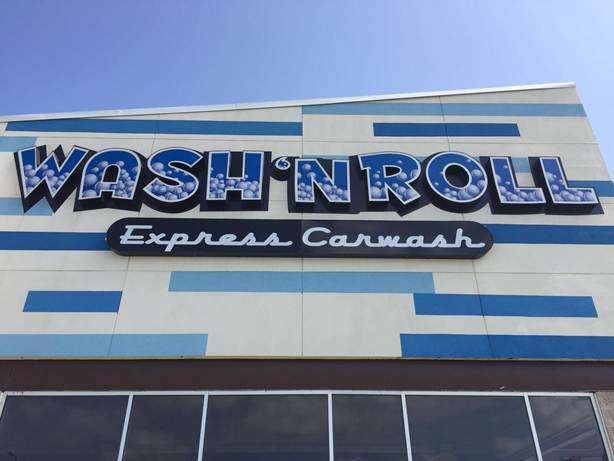
Photo caption: A well-placed custom business sign improves visibility, reinforces brand recognition and helps customers easily locate Wash'NRoll Express Carwash.
2. Execute a Comprehensive Visibility and Traffic Angle Site Survey
A sign that looks stunning on a 4K design monitor can fail completely in the physical world if it is obscured by unexpected environmental blind spots. Visibility surveys are essential, as sightlines change dramatically when viewed from a vehicle moving at 45 MPH versus a pedestrian on a sidewalk.
Calculating the Legibility Index for Vehicle Speeds
The standard rule of thumb for static text visibility states that every 1 inch of letter height provides roughly 10 feet of clear readability. However, this dynamic shifts when calculating for vehicular traffic:
Vehicle Speed (MPH) | Required Letter Height | Minimum Readable Distance |
25 MPH | 4 to 6 inches | 40 to 60 feet |
35 MPH | 8 to 10 inches | 80 to 100 feet |
45 MPH | 12 to 15 inches | 120 to 150 feet |
55+ MPH | 18+ inches | 180+ feet |
Factoring in Seasonal and Environmental Obstructions
A site survey must account for four-season variables. A spot that seems wide open in January might be entirely masked by dense oak tree canopies come June.
- Utility Infrastructure: Are overhead power lines or traffic signal arms cutting through your prime sightlines?
- Competing Visual Noise: Does the adjacent business feature a massive, flashing electronic sign that will visually swallow your minimalist, unlit storefront display?
3. What are the most durable materials for outdoor signs?
Choosing materials based solely on aesthetics or upfront cost is a recipe for premature degradation. Sun, moisture, extreme temperature shifts and wind loads tear down cheap substrates in months.
Choosing Substrates Built to Endure
- Aluminum and ACM (Aluminum Composite Material): The industry standard for structural longevity, ACM offers incredible rigidity without the heavy weight of solid steel, making it impervious to rust, warping and extreme thermal expansion.
- Acrylic vs. Polycarbonate: For illuminated sign faces, acrylic offers beautiful gloss and clarity but can crack under heavy hail impact. Polycarbonate provides bulletproof durability against vandalism and high storms, though it requires specialized UV coatings to prevent yellowing over time.
- High-Density Urethane (HDU): The premier choice for dimensional, routed or sandblasted artisan signs. Unlike natural wood, HDU will never crack, rot, split, or absorb moisture.
Calculating Wind Load and Structural Integrity
For large exterior pylon signs, flag structures or high-rise building wraps, local building codes mandate specific wind-load engineering calculations. Your custom signs must be structurally engineered to withstand regional gale forces — often up to 110 – 130 MPH in coastal zones. This requires certified engineering drawings (wet-stamped prints) detailing internal steel framing and concrete footer depths.
4. Align the Design Package with Global Brand Standards
Physical branding requires a completely different approach to color theory and typography than digital or print marketing. If your brand design and guidelines were designed primarily for mobile screens and PDF pitch decks, they will face serious friction when translated to metal, acrylic and LEDs.
Translating Digital RGB/Hex Codes to Physical Media
RGB pixels emit light; CMYK ink reflects light; paint and vinyl pigments possess entirely independent chemical structures. For absolute brand cohesion across multi-site installations, require your graphics partner to map your brand assets directly to physical color indexing standards:
- Pantone Matching System (PMS): Crucial for specifying paint formulations for structural returns and backgrounds.
- Cast Translucent Vinyl Specs: Essential for illuminated signs where the internal LED light source will alter the perceived color value of the face film at night.
Typography Optimization for Low-Light and High-Contrast
Elegant, ultra-thin serif fonts work beautifully on an executive website header, but they vanish entirely when backlit at night or viewed from a distance.
- Stroke Width: Ensure letter stems are thick enough to house internal LED modules without creating dim spots or "hot spots."
- Kerning and Tracking: Open up the spacing between letters. When text is illuminated or highly reflective, light bleeds slightly outward (irradiation), which can blur tightly spaced letters together into an unreadable block.
5. Map the Complete Customer Journey with Strategic Wayfinding Signage
Exterior signs act as a hook, but your interior environmental graphics handle the heavy lifting of customer conversion, brand immersion and spatial navigation. A broken internal wayfinding signage system creates subtle user frustration that damages brand perception and customer experience.
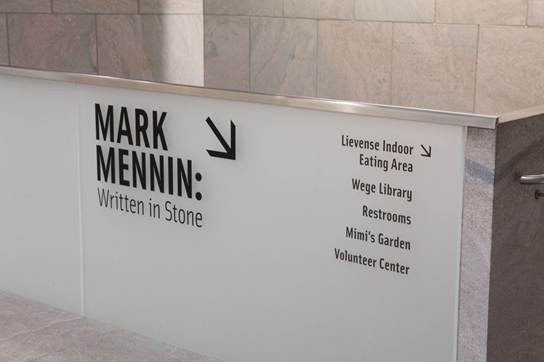
Photo Caption: Interior wayfinding signage helps customers navigate offices, healthcare facilities, schools, and retail environments while reinforcing your brand.
The Four Pillars of Architectural Wayfinding Signage
To create an intuitive physical environment, your internal graphics strategy must deploy all four core sign types seamlessly:
- Identification - Marks destination points (e.g., “Conference Room A,” “Suite 400”).
- Directional - Guides movement dynamically (e.g., elevator banks, chevron wall decals).
- Informational - Provides essential context (e.g., hours of operation, Wi-Fi access codes).
- Regulatory - Enforces safety and structural compliance (e.g., fire exits, capacity limits).
Eliminating Spatial Friction and Decision Fatigue
Walk through your location through the eyes of a first-time visitor. Where do they hesitate? Where do delivery drivers invariably get lost? Use architectural focal points to anchor your core messages. High-traffic crossroads demand clear overhead dimensional directory signs, while transactional zones benefit from localized wall murals or dimensional logo walls that validate the customer's arrival.
6. Guarantee Strict ADA Sign Compliance and Universal Accessibility
The Americans with Disabilities Act (ADA) features highly specific, legally enforceable architectural standards for permanent interior signage. Non-compliance leaves your enterprise open to costly civil litigation, architectural injunctions and federal penalties.
Rules for Tactile Text, Braille and Spatial Mounting
Any sign identifying a permanent room or space (restrooms, electrical closets, exits, stairwells) must follow strict accessibility formulas:
- Grade 2 Braille: Must feature domed, raised dots arranged in specific cell spacing—flat, printed dots or jagged, routed indentations do not comply.
- Tactile Character Height: Raised lettering must be raised a minimum of 1/32-inch from the background substrate and stand between 5/8-inch and 2 inches in height.
- Mounting Elevation: The baseline of the lowest tactile character must sit at least 48 inches above the finished floor, and the baseline of the highest character cannot exceed 60 inches.
Contrast Ratios and Non-Glare Finishes
ADA sign regulations require high visual contrast between the text characters and their background field — ideally a 70% contrast ratio or greater. Furthermore, both the characters and the background substrate must feature an absolute matte, eggshell or non-glare finish to remain legible under harsh overhead commercial lighting for individuals with low vision.
7. Audit Power Infrastructure and Energy Efficiency Specs
If your project requires illuminated monument signs, front-lit channel letters or high-impact digital messaging centers, you are managing an active electrical installation. You must prep your building's electrical infrastructure before the sign installation truck arrives.
Securing the Right Electrical Feeders and Dedicated Circuits
Illuminated signs require dedicated, low-voltage power lines run directly to the mounting location.
- Voltage Drop Calculations: For long exterior wire runs (e.g., from the main electrical room out to roadside monument signs), your electrician must calculate potential voltage drops to prevent flickering or premature transformer burnout.
- Access Points: Ensure your building features accessible drop ceilings or exterior access panels where UL-listed power supplies (transformers) can be safely housed, inspected and serviced.
Embracing Advanced LED Systems Over Legacy Lighting
In 2026, smart-grid sustainability and corporate ESG (Environmental, Social and Governance) targets mean legacy fluorescent and neon illumination are relics of the past. Modern LED modules deliver superior brightness (measured in lumens per watt) while consuming a fraction of the raw wattage. Ensure your configuration includes integrated photocells or programmable smart timers that automatically dim or shut down illumination during off-business hours to cut operational expenses and comply with local dark-sky laws.
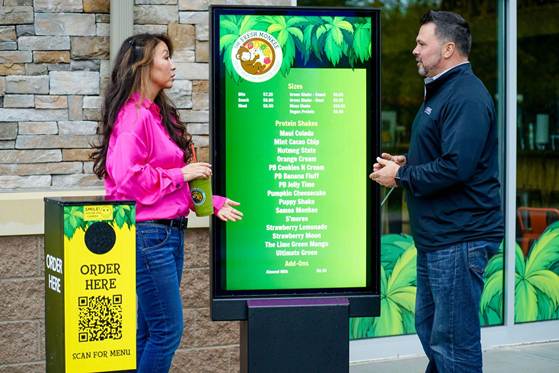
Photo caption: Energy-efficient LED business signs provide bright, long-lasting illumination while reducing maintenance and operating costs.
8. Assess Smart-Signage Integrations (NFC, QR and Spatial Tech)
In 2026, a sign is no longer just a static piece of architecture. It is a physical portal to your digital ecosystem. For modern marketing directors, integrating physical graphics with mobile interactions is a powerful way to capture real-world attribution data.
Embedding Frictionless Mobile Engagement Touchpoints
- Dynamic QR Nodes: Integrate high-contrast, stylized QR codes directly into window graphics, directional directories or point-of-purchase displays. Link these nodes to context-aware landing pages, real-time product inventory networks or instant digital wayfinding maps.
- NFC (Near Field Communication) Tags: For premium indoor environments or museum-style corporate history walls, embed low-profile NFC microchips behind acrylic panels. Users can simply tap their devices against the graphic to launch immersive product details, app downloads or secure event check-ins.
Prepping for Spatial Computing and Augmented Reality (AR) Overlays
As consumer eyewear and spatial computing platforms scale, physical signs act as foundational visual anchors for mixed-reality worlds. By utilizing clean, high-contrast structural silhouettes and distinct geometric design footprints, your physical business signage can double as a scannable "spatial marker." This allows passersby to view extended digital storefronts, interactive menu modules or virtual brand ambassadors superimposed directly over your physical building.
9. Calculate Total Cost of Ownership (TCO) vs. Initial CapEx
Smart marketing decision-makers view business signage as a long-term asset, not a short-term marketing expense. Evaluating a signage proposal based solely on the upfront production estimate completely ignores the downstream operational costs.
The Total Cost of Ownership Formula
When evaluating competing bids, build a comprehensive financial model that factors in structural lifespans and ongoing maintenance:
TCO = Initial Manufacturing Cost + Permitting & Engineering + Professional Sign Installation + Lifecycle Energy Consumption + Projected Maintenance/Repair
Factoring in Sign Installation and Logistical Complexity
The cost of building a sign is often entirely distinct from the cost of safely hanging it. A thorough estimate must clearly itemize specialized logistical needs:
- Heavy Machinery Rentals: Does your sign installation require high-reach bucket trucks, industrial cranes or public sidewalk closures that demand municipal traffic-control permits?
- Subsurface Footers: For roadside structures, does the installation quote include professional underground utility location scans (811 calls) and deep concrete excavation?
10. Partner with an End-to-End Visual Communications Expert
The ultimate safeguard against a failed sign installation is moving away from fragmented, transactional vendors and aligning with an end-to-end consulting partner. Managing a sign project by hiring an independent freelance designer, a standalone local permitting expeditor, an unverified sign fabrication shop and a third-party handyman installer creates massive structural gaps where critical details get lost in translation.

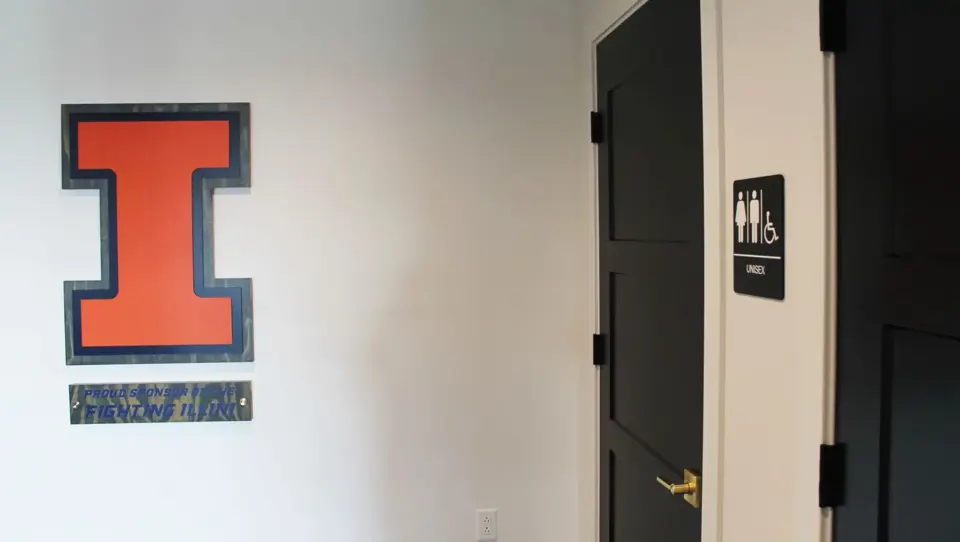
Photo caption: FASTSIGNS provides end-to-end custom signage solutions, from design and permitting to fabrication and professional installation.
Why Corporate Decision-Makers Choose FASTSIGNS
Enterprise-level signage demands unified project management. When you partner with an established industry leader like FASTSIGNS, you gain a dedicated team that handles the entire lifecycle of your physical brand:
- Strategic Consultations: Aligning your overarching marketing objectives and business challenges with targeted, high-impact signage strategy.
- Comprehensive Project Management: Managing everything from initial site surveys, complex municipal zoning approvals and landlord negotiations to structural engineering blueprints.
- Cutting-Edge Fabrication: Leveraging state-of-the-art material printing, precision CNC routing and high-efficiency electrical assembly.
- Certified Sign Installation: Deploying professional, fully insured sign installation experts who understand local structural codes and safety regulations.
By trusting your visual identity to a comprehensive partner, you eliminate administrative overhead, secure reliable timelines and ensure that your physical branding assets deliver a powerful, unambiguous return on investment (ROI) from the very first day they are unveiled.
How Do I Choose the Right Business Sign for my Location?
Keep this concise checklist on hand before signing off on your final production proof:
- [ ] Zoning and Code Check: Confirmed allowable square footage and secured all necessary municipal permits.
- [ ] Landlord Approval: Obtained formal, written sign-off from property management or tenant boards.
- [ ] Site Survey: Verified vehicle-speed legibility indexes and accounted for seasonal tree/utility blockages.
- [ ] Material Spec: Selected climate-appropriate, wind-load-tested substrates (e.g., ACM, HDU, Polycarbonate).
- [ ] Color Mapping: Cross-referenced all digital Hex codes with exact physical PMS paint and translucent vinyl indexes.
- [ ] ADA Sign Compliance: Verified Grade 2 Braille specs, tactile font sizing and correct wall-mounting heights.
- [ ] Electrical Prep: Installed dedicated low-voltage circuits and mapped clear access paths to transformers.
- [ ] Digital Integration: Optimized QR codes, NFC tags or spatial computing anchors for mobile engagement.
- [ ] Financial Modeling: Formulated a 5-to-10-year Total Cost of Ownership (TCO) budget rather than just tracking upfront production costs.
- [ ] Signage Partner Alignment: Contracted an end-to-end visual communications provider to oversee execution from design to installation.
Ready to transform your physical space and amplify your brand's market presence? The visual communication experts at FASTSIGNS are equipped to streamline your next graphics deployment. From initial site audit through structural installation, we handle the complexities so you can focus on leading your business. Contact your local FASTSIGNS center today to schedule your strategic brand strategy consultation.
.jpg.0000000000000.webp)

.jpg.webp)

